

Noma = No-Mas?
One Night Dining in the Belly of the Beast

In the modern history of fine dining, it’s probably fair to say that no restaurant has had a greater influence than Noma. Founded in Copenhagen in 2003 by René Redzepi and Claus Meyer, the restaurant is widely credited with helping define, formalize, and popularize New Nordic cuisine—a culinary movement that has shaped much of the global fine dining landscape over the past twenty years.
So when it was announced last July that Noma would be bringing its next residency to Los Angeles following the end of regular restaurant operations in late 2024, the level of anticipation was understandably immense. In preparation for the project, much of the team spent the latter half of 2025 in California, researching, experimenting, familiarizing themselves with the state’s landscapes, ingredients, and history, while also building relationships with local purveyors and members of the food community.
The goal was to combine those experiences with the Noma team’s creative sensibilities and Nordic perspective, with the resulting work ultimately presented to guests throughout the residency. Alongside the pop-up, a temporary Noma Projects Shop would open in Silver Lake, with additional collaborations planned alongside several Los Angeles restaurants.
It was eventually revealed that Noma LA would run from March 11th through June 26th, and when reservations were released at the end of January, they disappeared within minutes. Like many others, I initially failed to secure a booking. However, shortly before the residency began, allegations surrounding Redzepi’s past workplace behavior surfaced publicly, leading the chef to step away from his role at the restaurant.
As a result, the original question—“What would Noma look like in Los Angeles?”—suddenly came paired with another: “What would Noma look like without René?” It felt worth seeing firsthand, so when a last-minute reservation for a solo seat at a shared table appeared on Tock, I decided to take the plunge.
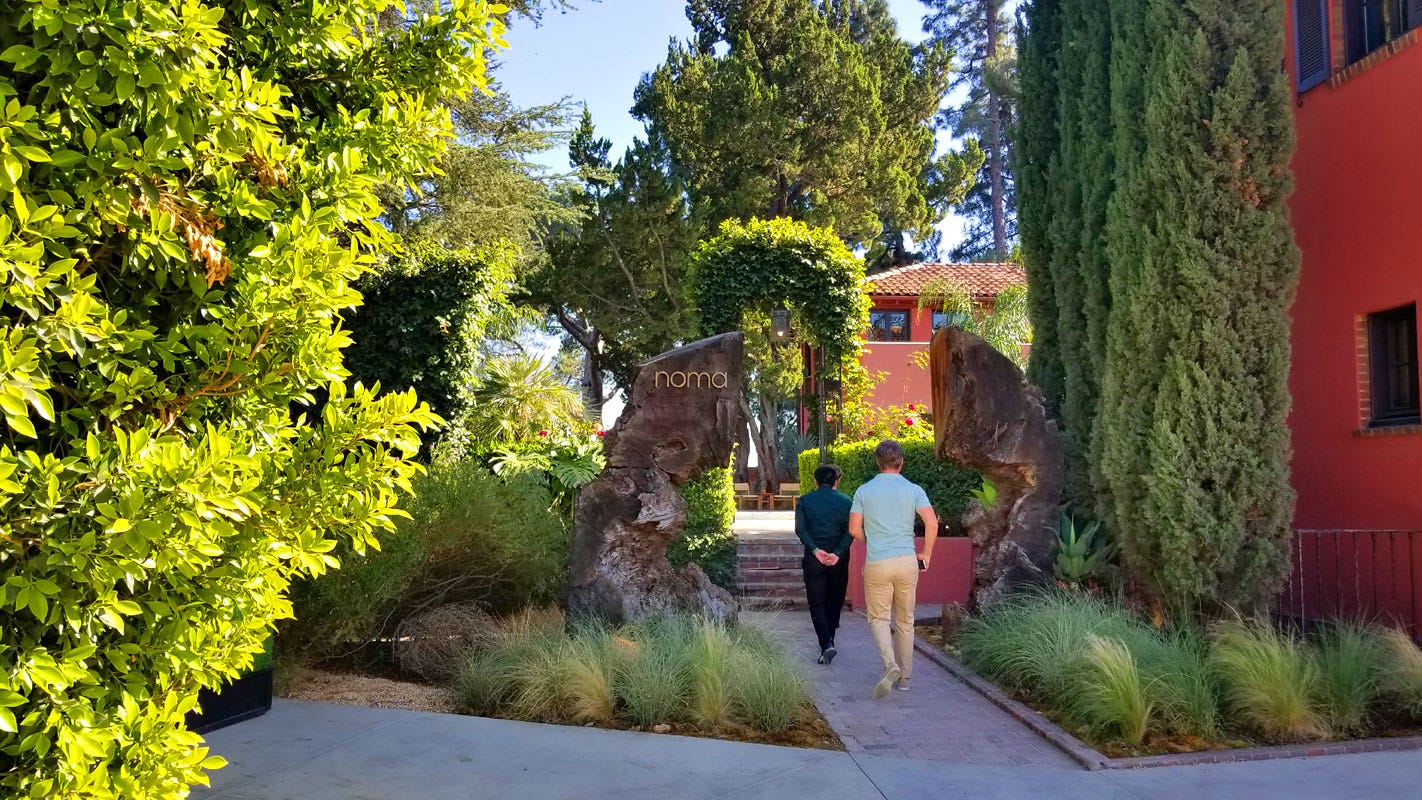
The residency took place at the Paramour Estate—also known as the Crestmount Estate or the Canfield-Moreno Estate—a designated Los Angeles Historic-Cultural Monument. Located in the affluent Moreno Highlands neighborhood of Silver Lake, the mansion was originally built in 1923 in the Mediterranean Revival style. For 25 years, the property was owned by interior designer and restaurateur Dana Hollister (4100 Bar, Bordello, Brite Spot, Cliff’s Edge, One-Eyed Gypsy, Villains Tavern) before eventually being sold to fellow designer Ken Fulk in 2023.
Although complimentary valet parking was available onsite, I opted to park on the street instead—apparently a bit too far downhill, as the walk back up Micheltorena ended up being a fairly steep climb. Pictured above is the view just beyond the entrance gates.

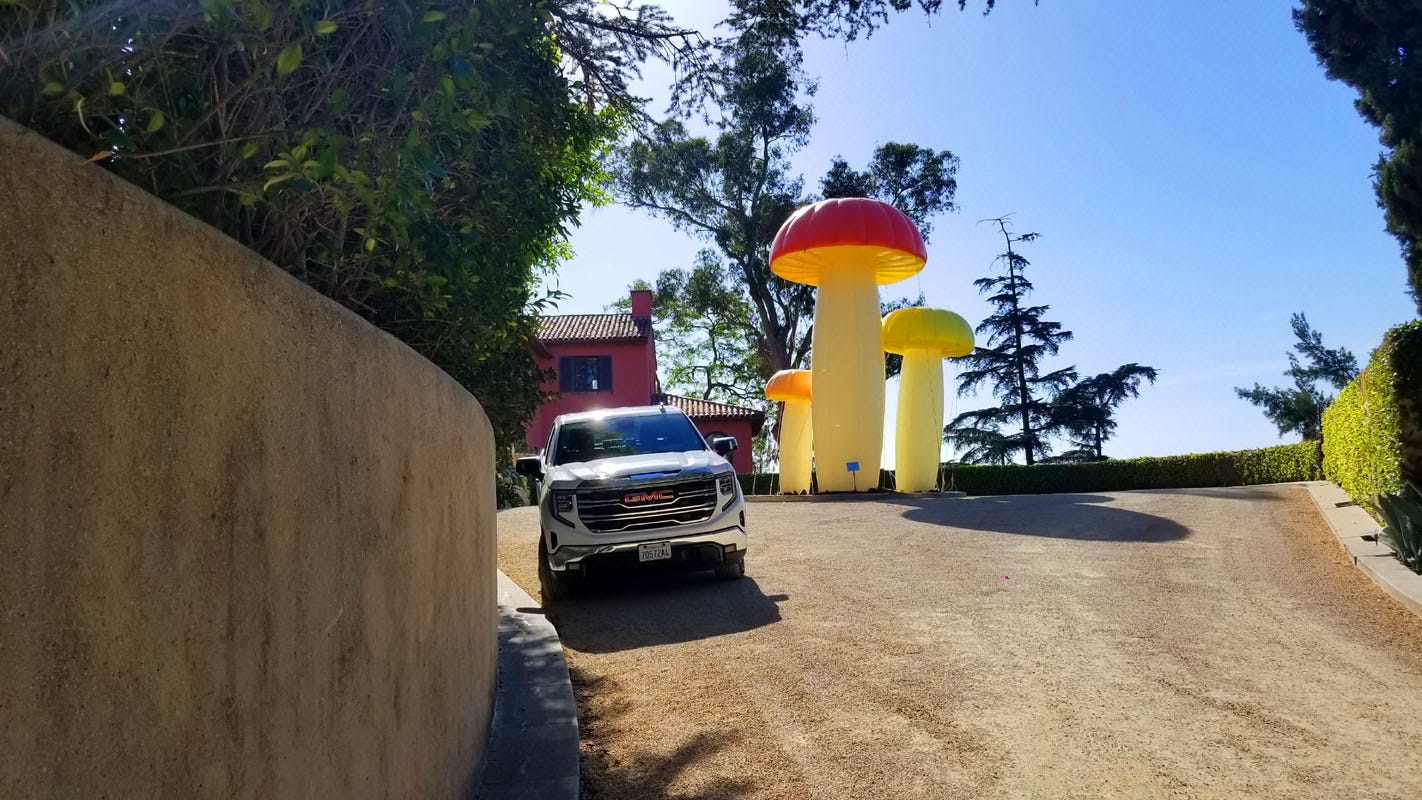
Perched high atop a hill, the estate offered a striking view from the motor court, overlooking Franklin Hills, Los Feliz, and the surrounding stretch of Los Angeles beyond.
From the vantage point above, turn around, go past the inflatable mushrooms, and you’ll find a path...
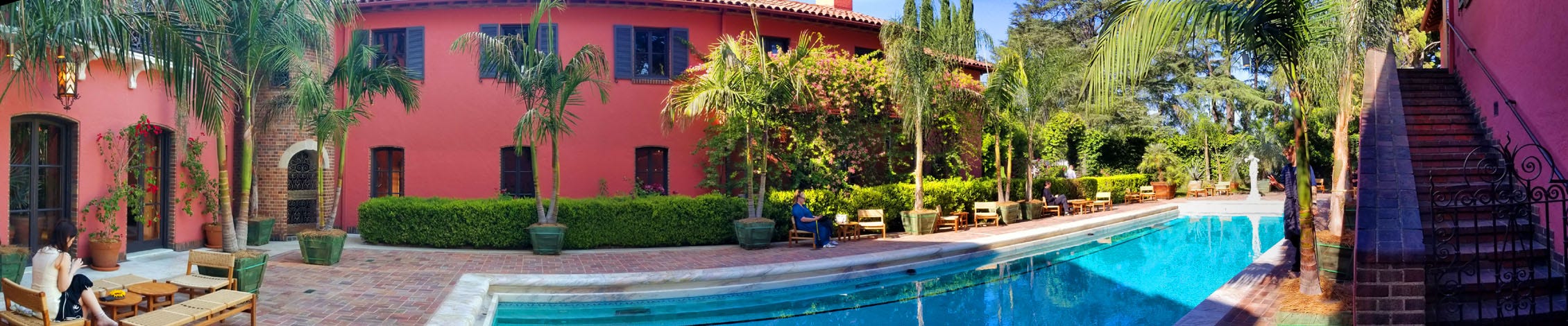
...Leading to the swimming pool courtyard, where guests were asked to assemble.
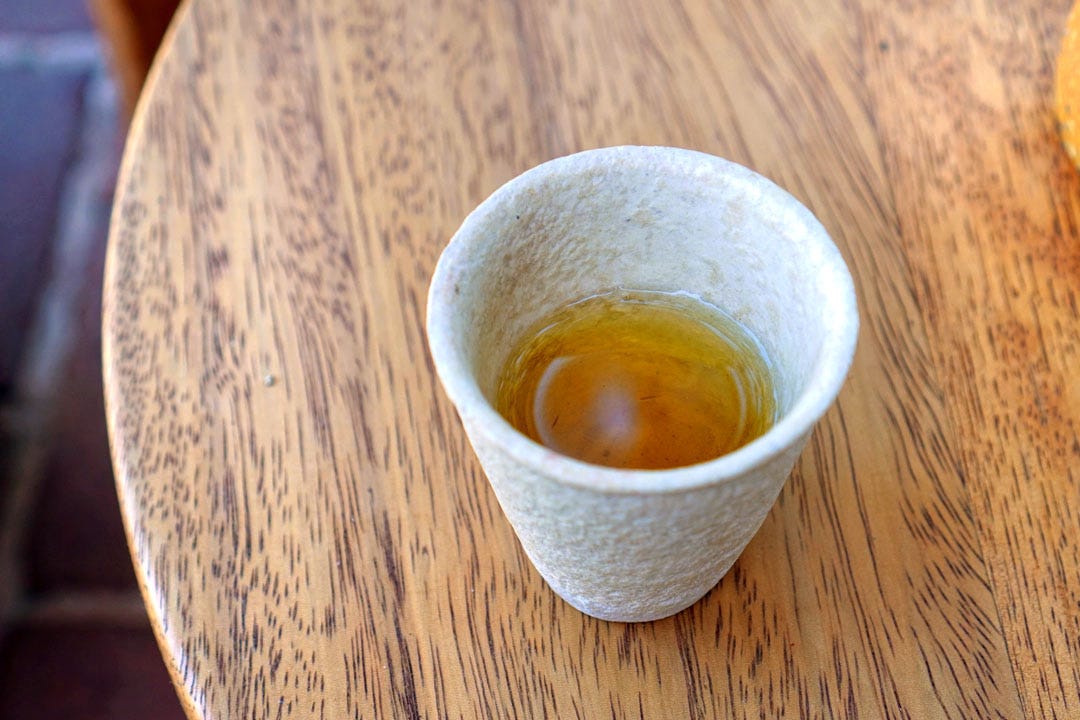
Shortly after arriving, I was handed a cup of hojicha-inspired lemon leaf infusion. Alongside the expected citrusy and herbaceous qualities, there was also an almost corn-like note that felt oddly familiar. Light, refreshing, and easy to drink—I ended up going back for a second serving.
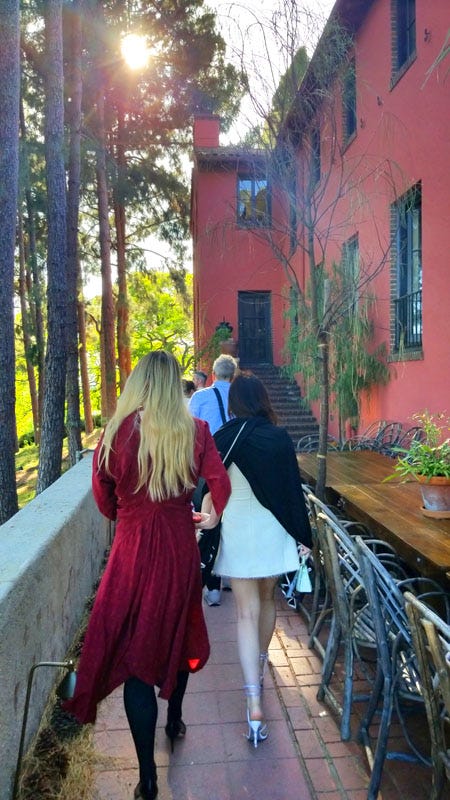
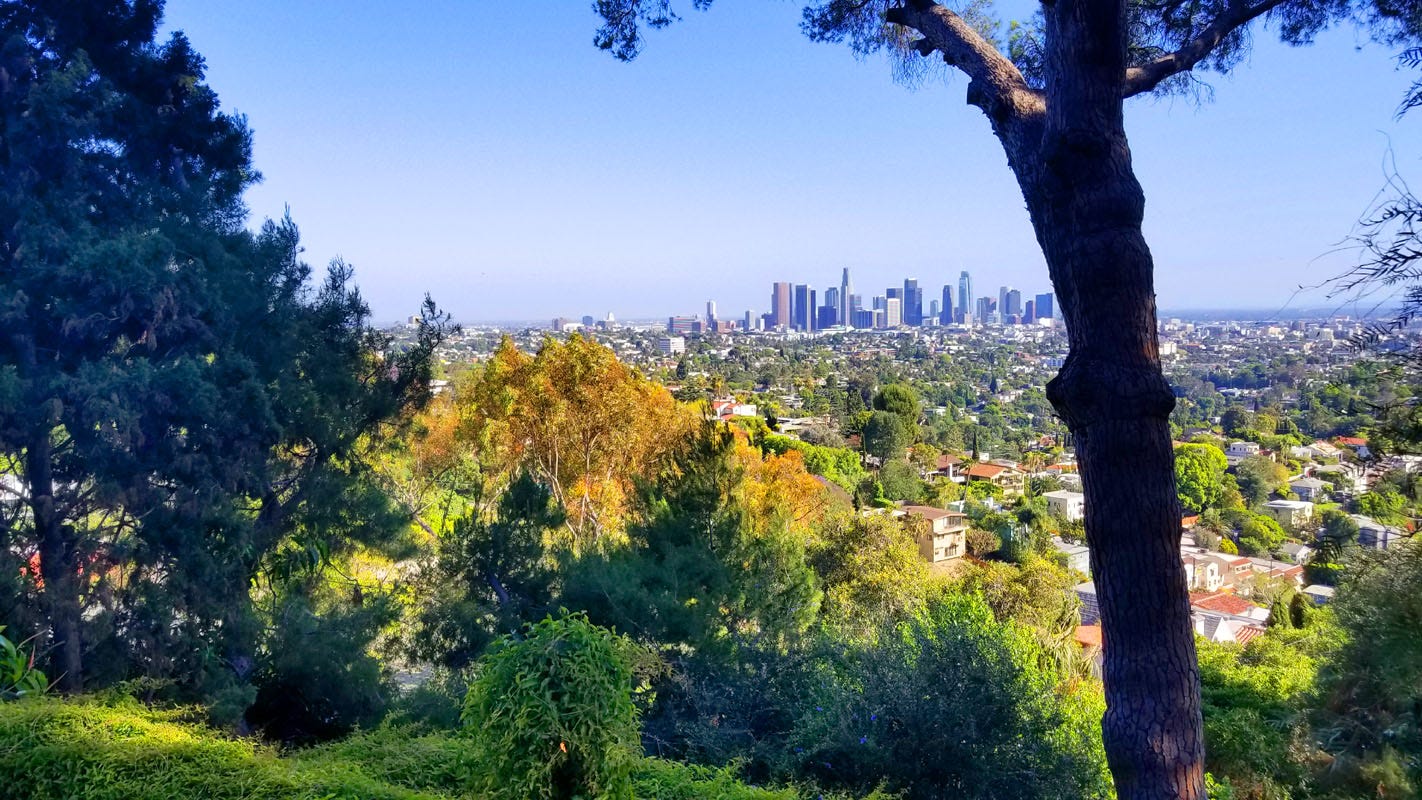
After about twenty minutes or so, a group of us from the first seating at the shared table were escorted away. We made our way around the southern edge of the estate, catching intermittent views of the Downtown Los Angeles skyline off in the distance.
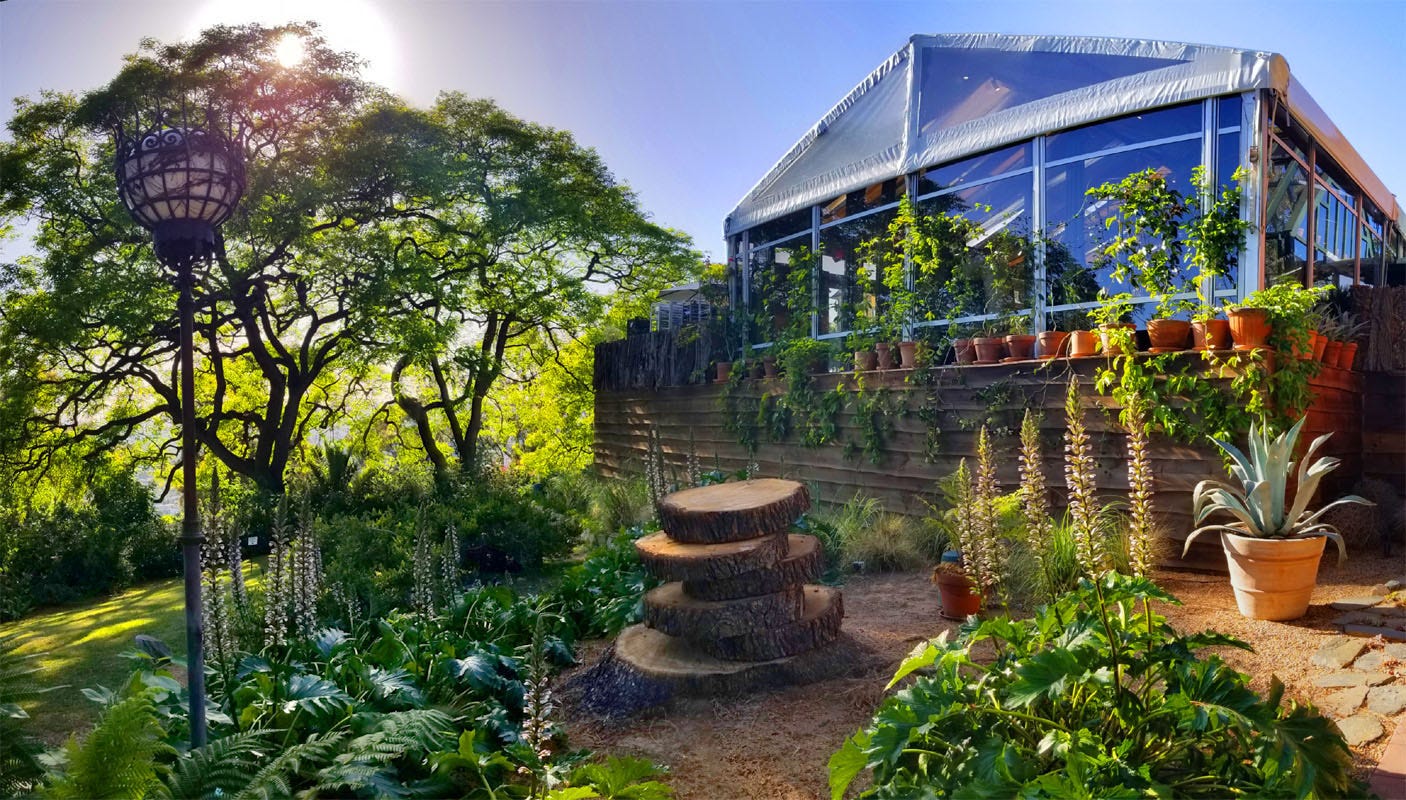
At the western end of the property, the Noma crew had constructed a greenhouse-style kitchen on the mansion’s lawn. We moved past the kitchen entrance to be greeted by the back-of-the-house staff…
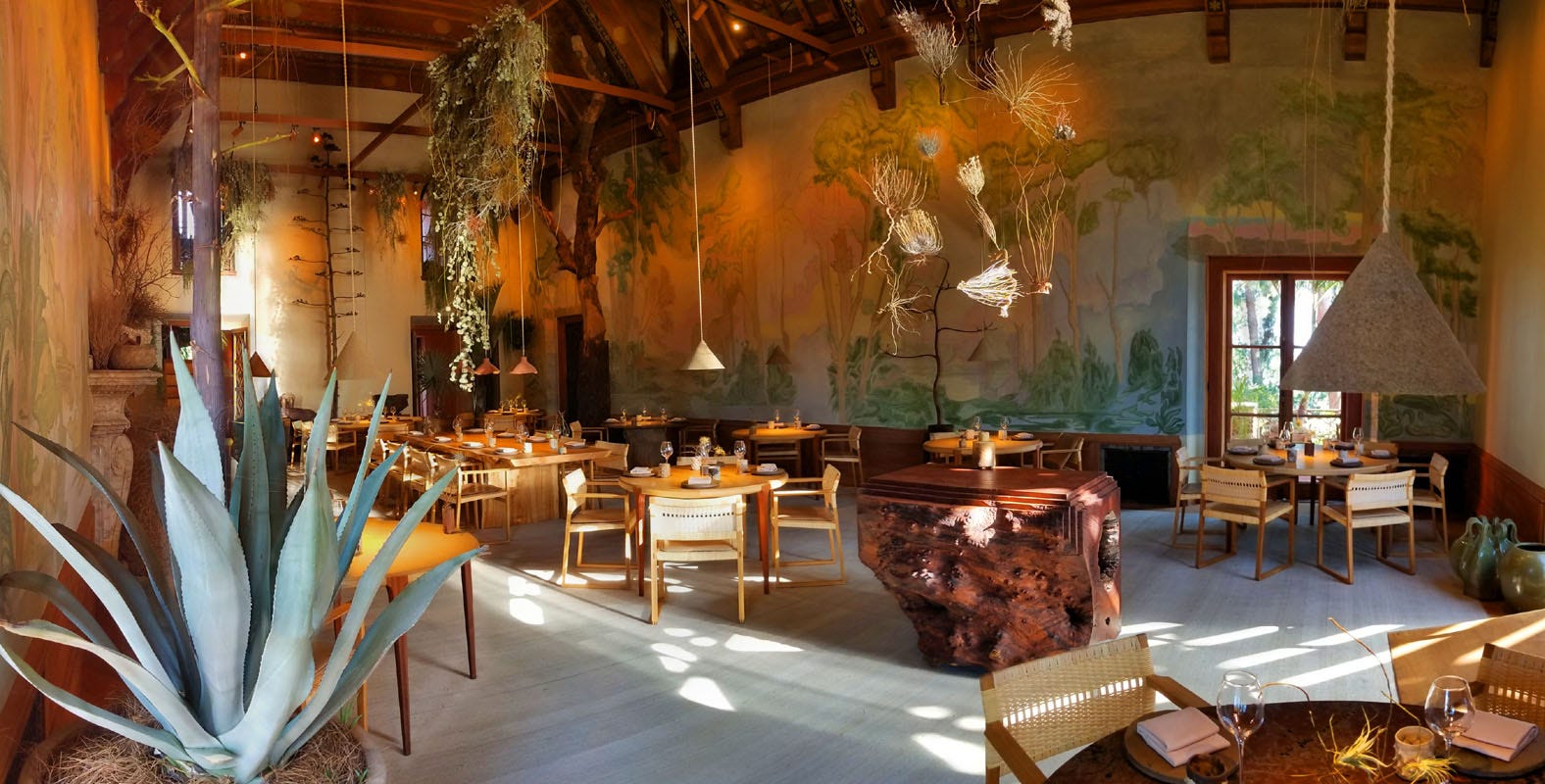
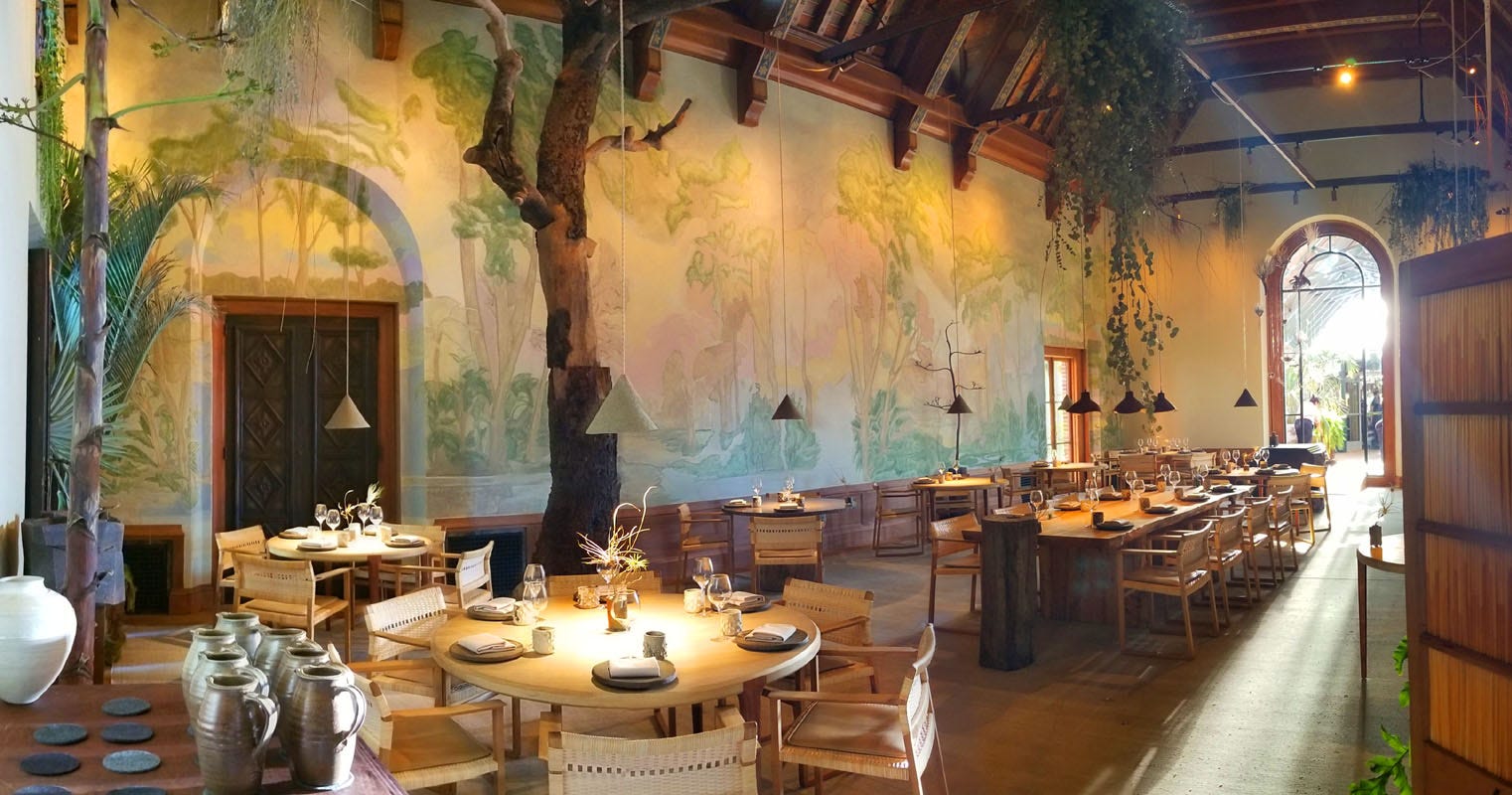
...Before eventually being led east through the main dining room, a repurposed ballroom that served as the centerpiece of the residency. The team did an impressive job with the space, recreating much of the atmosphere and aesthetic language of the København restaurant while adapting it with a distinctly Southern California sensibility.
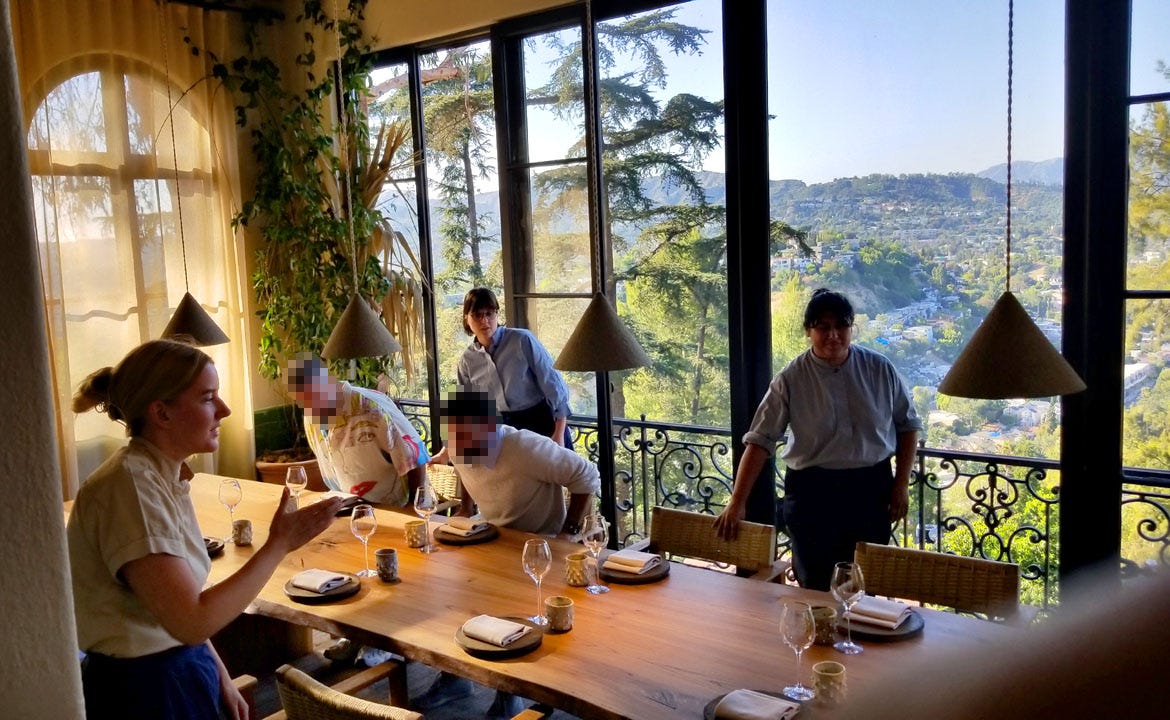
However, our shared table wasn’t located in the main dining area, but instead a lovely eight-seater private dining room (the repurposed sunroom) located at the northern extremity of the building.
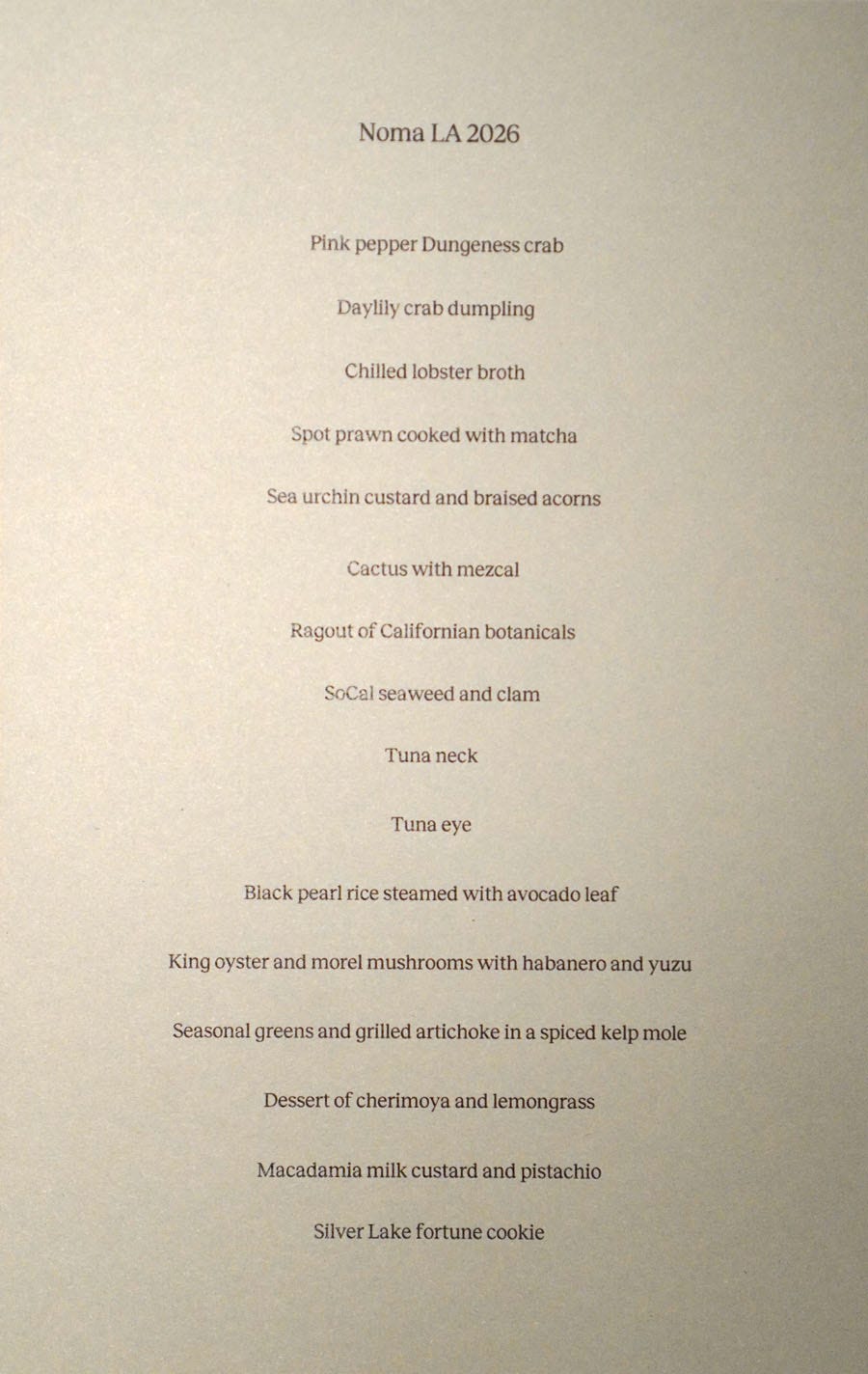
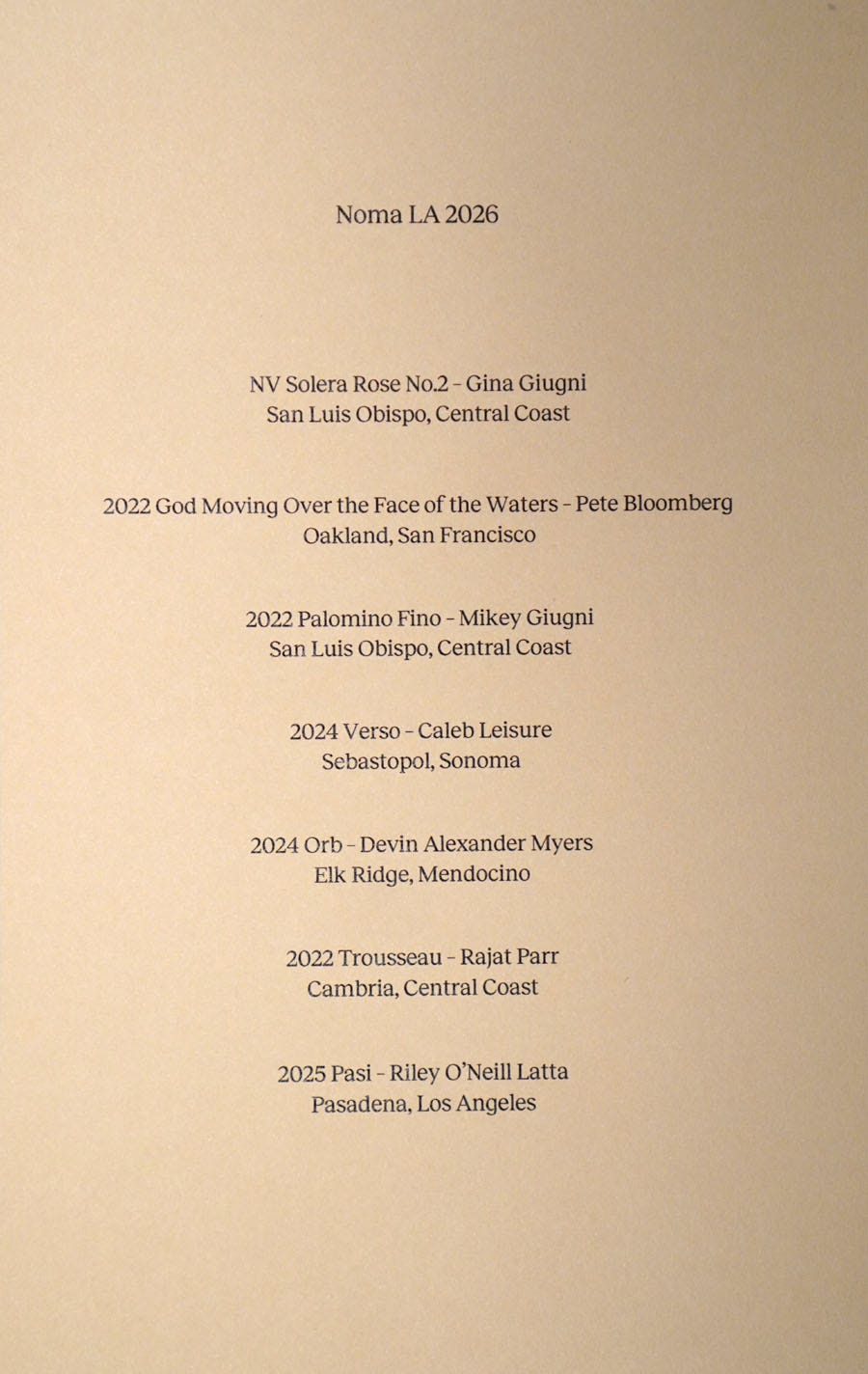
Shown above is the menu presented at the conclusion of the evening. The experience was priced at $1,500 per person, inclusive of tax, gratuity, and beverages. Also included was a wine pairing built around natural-leaning Californian producers, though a non-alcoholic pairing featuring housemade infusions, kombuchas, juices, and similar preparations was available as well—an option I ultimately skipped.
Guests were also given the opportunity to purchase bottles from the wine list, which interestingly contrasted heavily with the pairing selections themselves: far more classical in style, predominantly French, and considerably more expensive. Additionally, for a $150 corkage fee, diners could open bottles brought from home if desired.
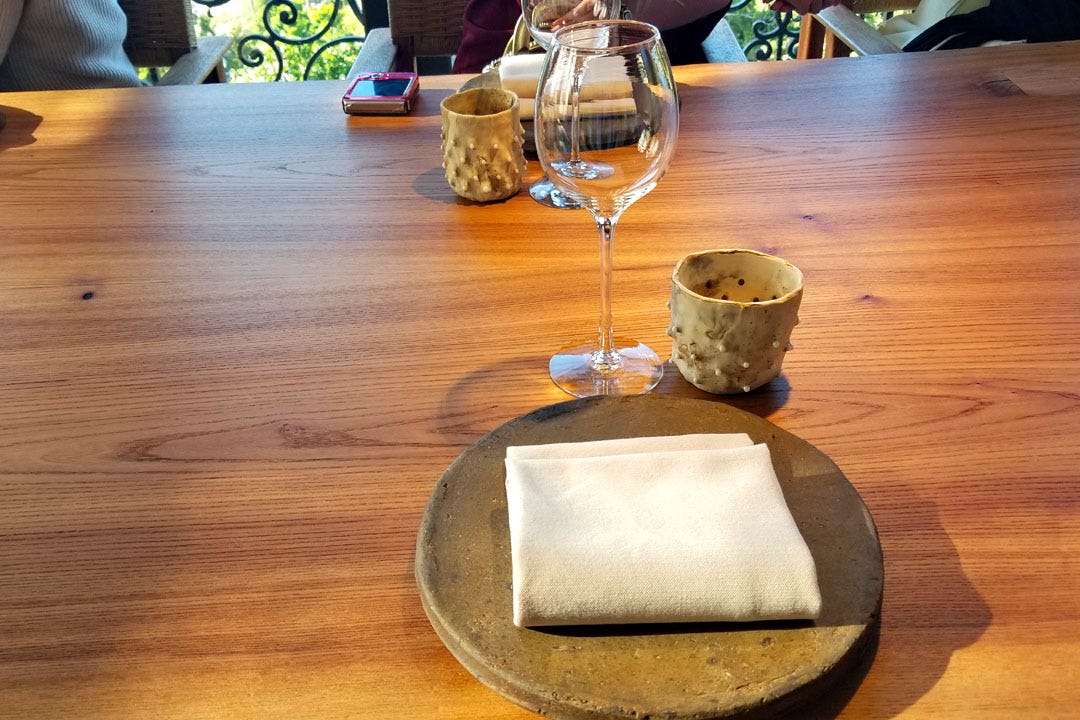
The place setting awaited the eight of us at the table. It was an eclectic mix of diners, to put it lightly.
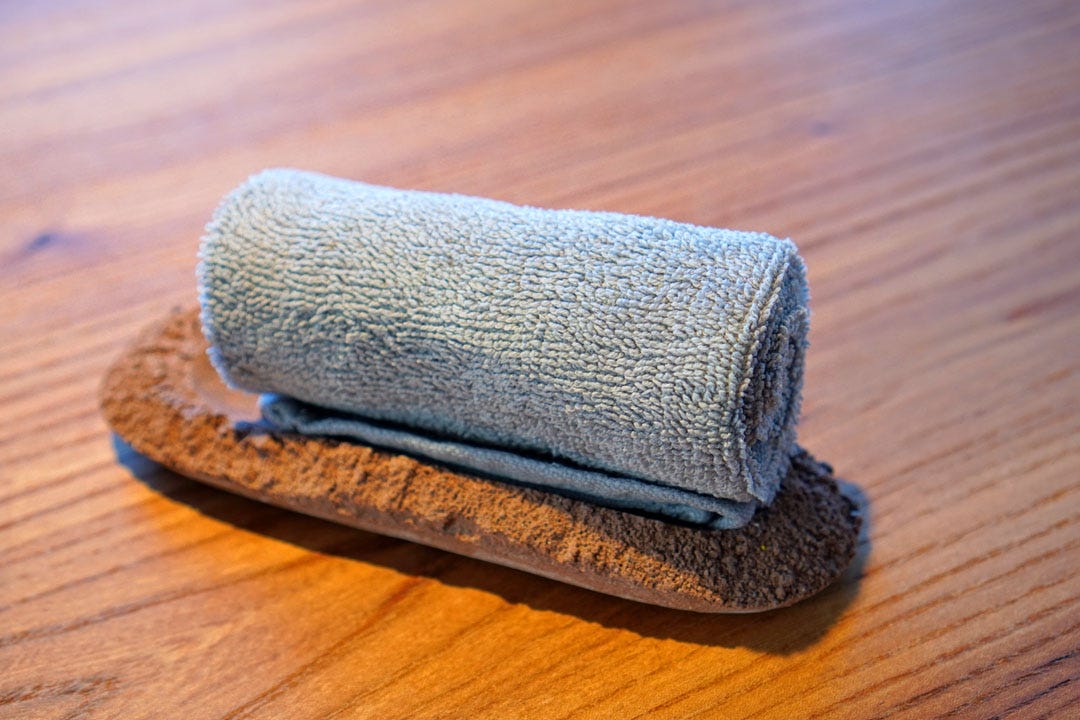
A chilled, wetted hand towel soon made an appearance A much-appreciated touch that I’d like to see more often in haute cuisine.
NV Solera Rose No.2 - Gina Giugni, San Luis Obispo, Central Coast
To accompany the meal, guests were poured seven wines throughout the evening, with refills offered fairly generously. The first pairing was a sparkling rosé from San Luis Obispo producer Lady of the Sunshine. Made from Pinot Noir, the wine consisted of roughly one-quarter 2025 vintage juice blended with a solera base incorporating wines from 2023 and 2024.
On the nose, it showed bright aromas of underripe orchard fruit, minerality, and subtle yeasty character. The palate leaned crisp and energetic, driven by tart apple notes layered with hints of stone fruit, mineral, and a slight astringency. Overall, it worked very well as an opening apéritif.
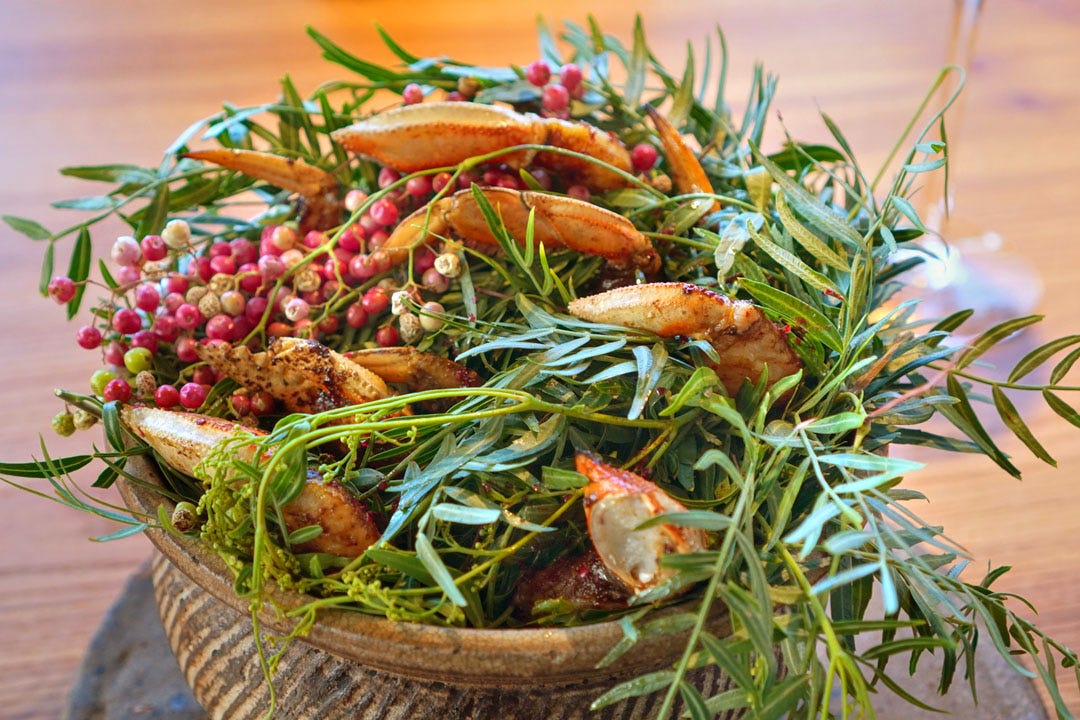
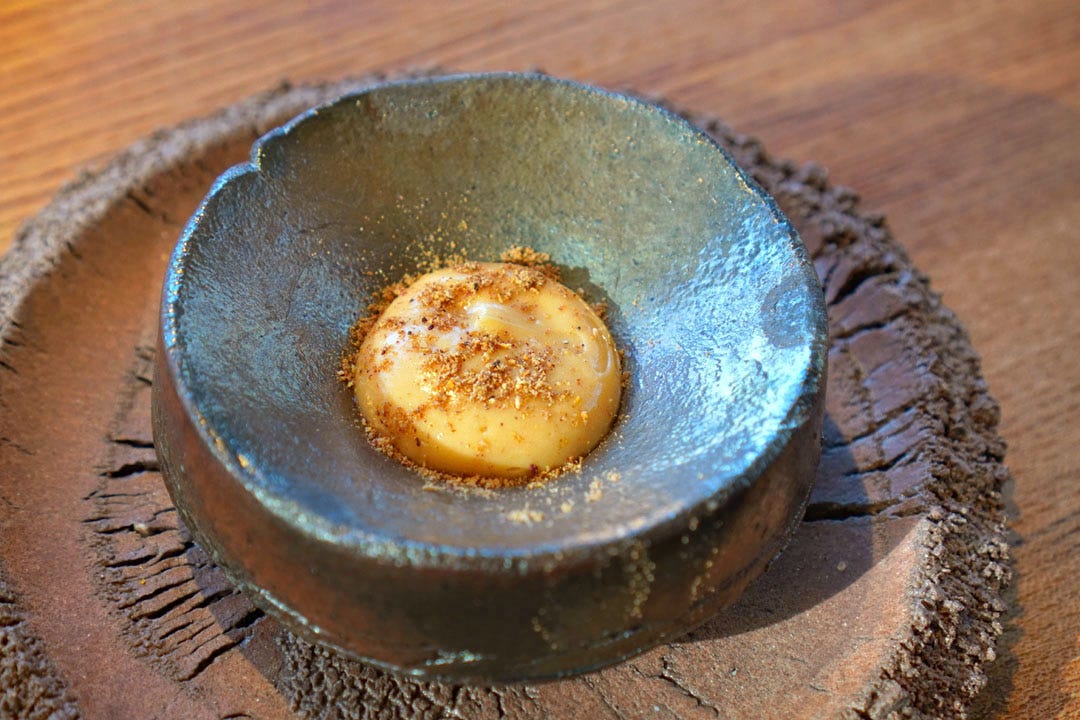
1: Pink Pepper Dungeness Crab:
The opening course showcased Dungeness crab, whose natural sweetness was complemented nicely by the smokier, deeper notes imparted from the barbecuing process, along with a restrained brightness from local pink peppercorns. Texturally, the crab landed exactly where I wanted it to—tender, delicate, and satisfying even on its own. Still, dragging each bite through the accompanying pink pepper butter sauce added another layer entirely, introducing lingering savory richness, nuttiness, and subtle sweet spice notes that rounded out the dish beautifully.
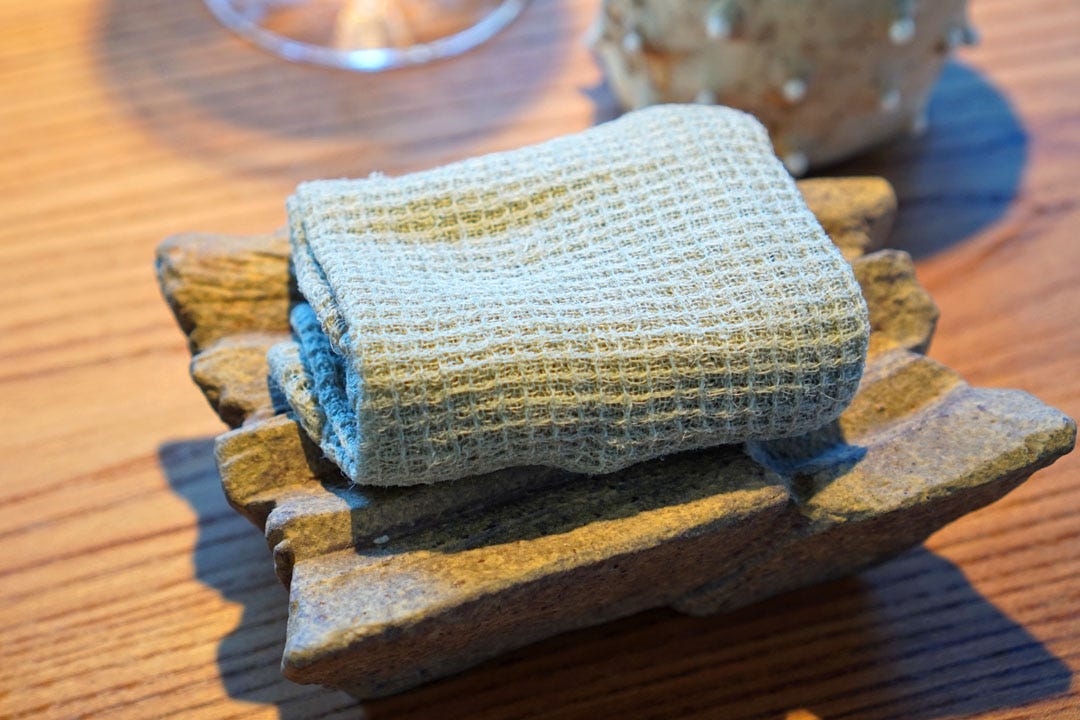
A moistened napkin was soon provided, which was quite welcomed given the hands-on nature of the preceding course.
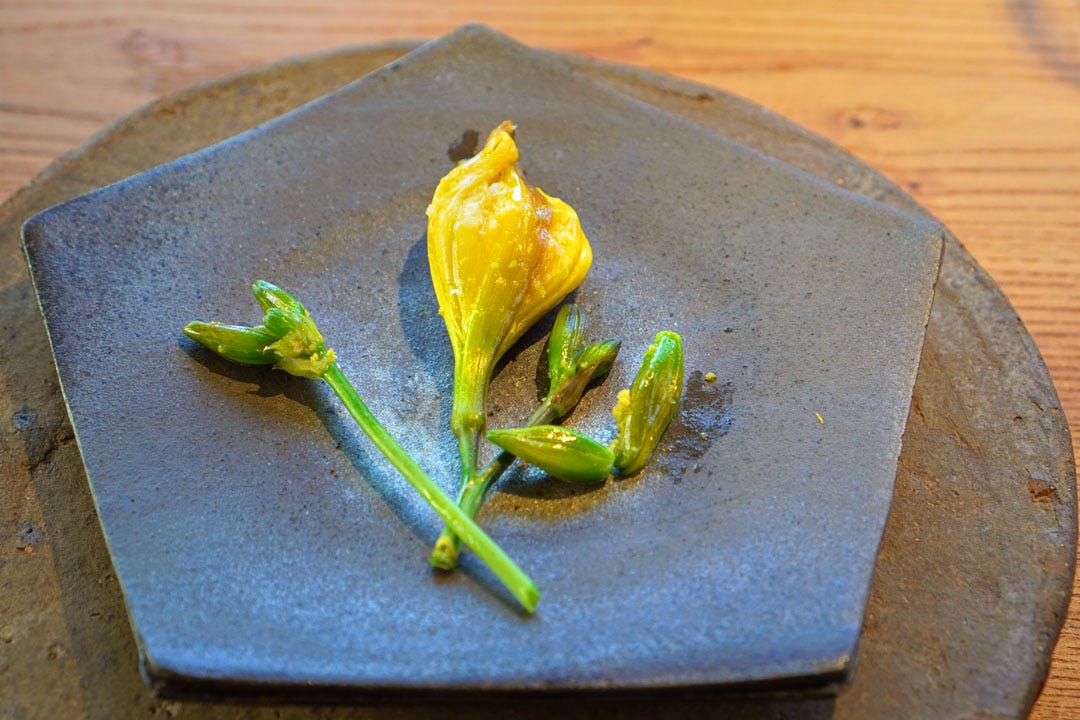
2: Daylily Crab Dumpling:
A second Dungeness crab preparation featured meat from the body of the crustacean stuffed into a steamed day lily flower and finished with rose oil. I ended up preferring this course even more, largely because the sweet salinity of the crab integrated surprisingly naturally with the blossom’s floral, herbaceous qualities. Meanwhile, the crisp vegetal buds of the plant had been injected with concentrated crab broth, adding an extra burst of savory depth and another layer of texture to explore throughout the dish.
Another wet napkin quickly appeared.
2022 God Moving Over the Face of the Waters - Pete Bloomberg, Oakland, San Francisco
The evening’s second wine was a Chardonnay from producer Llewelyn, made using fruit sourced from Lolonis Vineyard in Redwood Valley, Mendocino County. The wine was produced from a barrel that remained untopped throughout aging, allowing it to mature sous voile and develop oxidative characteristics reminiscent of Jura wines.
On the nose, it leaned intensely nutty and funky in a way that immediately called that region to mind. The palate, however, moved in a brighter direction, showing sweeter citrus and orchard fruit notes alongside grassy undertones and a touch of barnyard character.
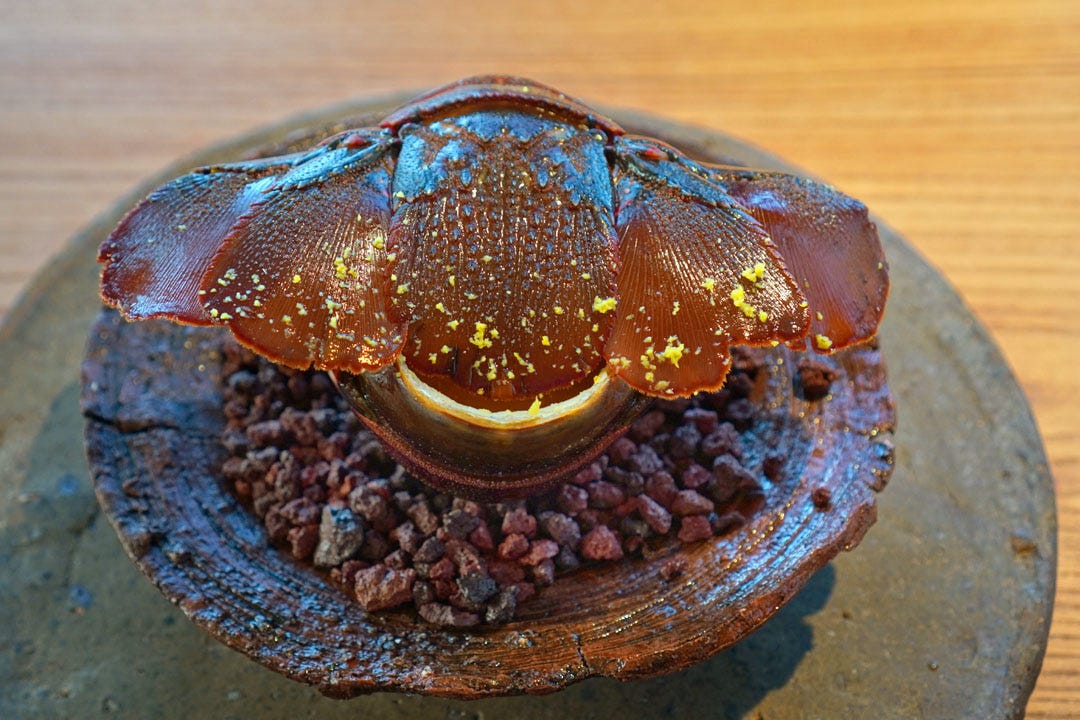
3: Chilled Lobster Broth
A lobster shell was repurposed into a drinking vessel, with guests instructed to pull out the center portion of the tail before sipping the broth inside—a preparation combining lobster with elderflower and bergamot. The result was more nuanced and unexpected than I initially anticipated, as the floral elements added an entirely different dimension to the crustacean’s naturally savory, saline character rather than overpowering it.
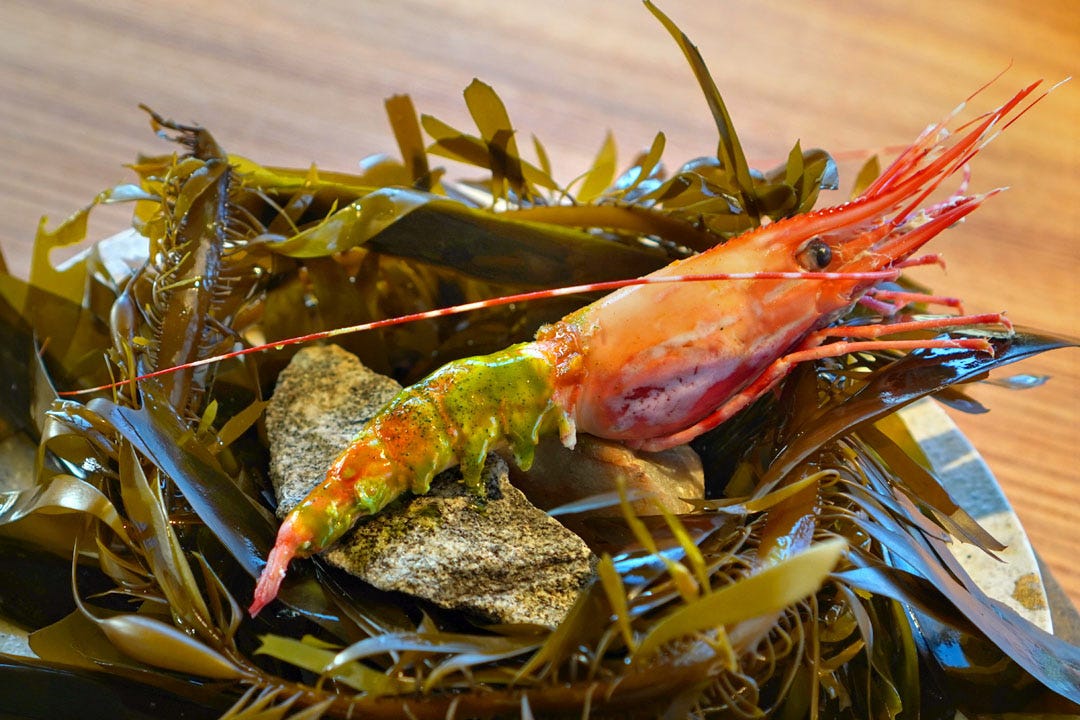
4: Spot Prawn Cooked with Matcha
Santa Barbara spot prawn was cooked à la minute, its sweet, oceany flavors matching up cleverly with the grassy, vegetal bitterness of green tea. Filled with a tangy dried tomato paste, the shrimp’s even headier head was also a treat, so be sure to give it a suck (pause).
A third and final wetted napkin was now provided.
2022 Palomino Fino - Mikey Giugni, San Luis Obispo, Central Coast
Next to imbibe was an old vine Palomino Fino from Scar of the Sea, a producer that happens to be run by the husband of the winemaker of the evening’s first pairing. Made with grapes from Galleano Ranch in Cucamonga Valley (planted in the 1920s), this was reportedly aged three years in old oak barrels, non-ouillé. This made for a funky, oxidative style of wine.
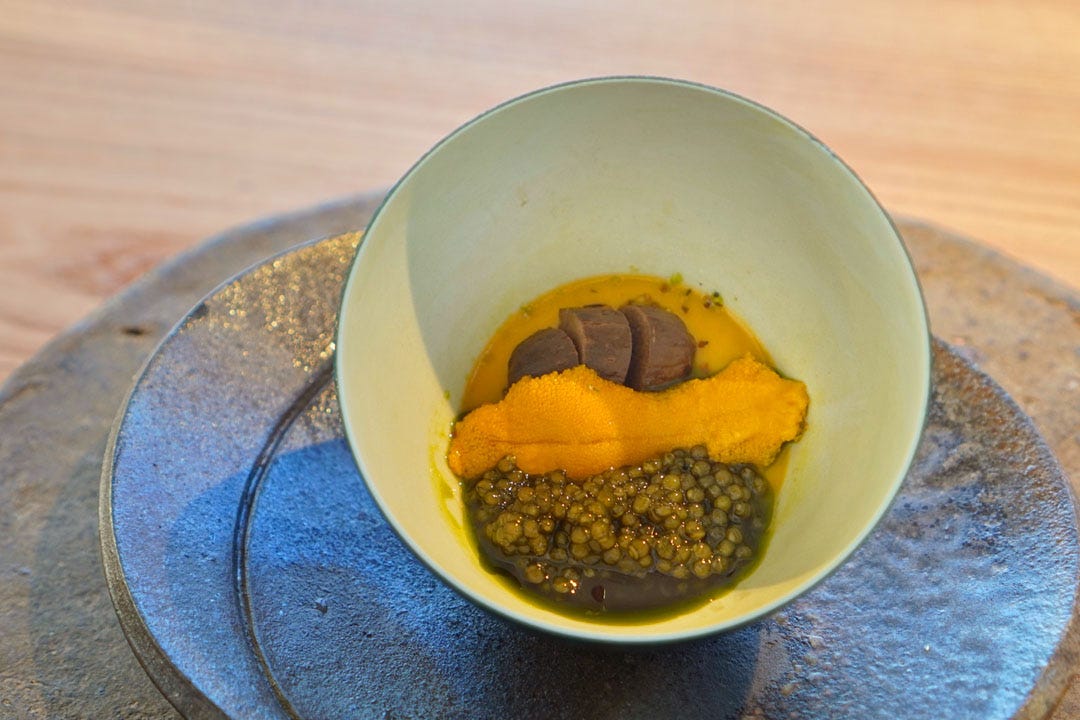
5: Sea Urchin Custard and Braised Acorns
Pacific sea urchin appeared here in both custard and tongue form, accompanied by caviar, hoja santa oil, and unexpectedly tender pieces of acorn. Acorn, apparently, had become a point of fascination for the kitchen due to its historical importance within the diets of local Native American communities, with the team treating the ingredient somewhat similarly to the pine cones used back in Copenhagen.
For me, the acorn ended up serving as the centerpiece of the dish, providing an earthy, nutty counterbalance to the sweeter and more saline flavors of the uni and caviar. Meanwhile, the peppery aromatics of the yerba santa tied everything together surprisingly elegantly. The bowl itself also deserves mention—it was actually an emu eggshell, repurposed after the kitchen had reportedly been experimenting with incorporating emu into the menu, given that the birds are farmed locally in California.
2024 Verso - Caleb Leisure, Sebastopol, Sonoma
The following three courses were paired with a 100% Sauvignon Blanc from Caleb Leisure, produced using fruit sourced from Mendocino’s Yorkville Highlands AVA. Drawing inspiration from traditional Georgian winemaking techniques, the wine was aged in kvevri—large amphora-like earthenware vessels that contributed a distinctive texture and character to the final product.
Aromatically, it came across quite intense, loaded with funky, almost cheese-like notes. On the palate, however, the wine felt energetic and vibrant, balancing grassy and tropical flavors with pronounced minerality and a pleasant tannic structure.
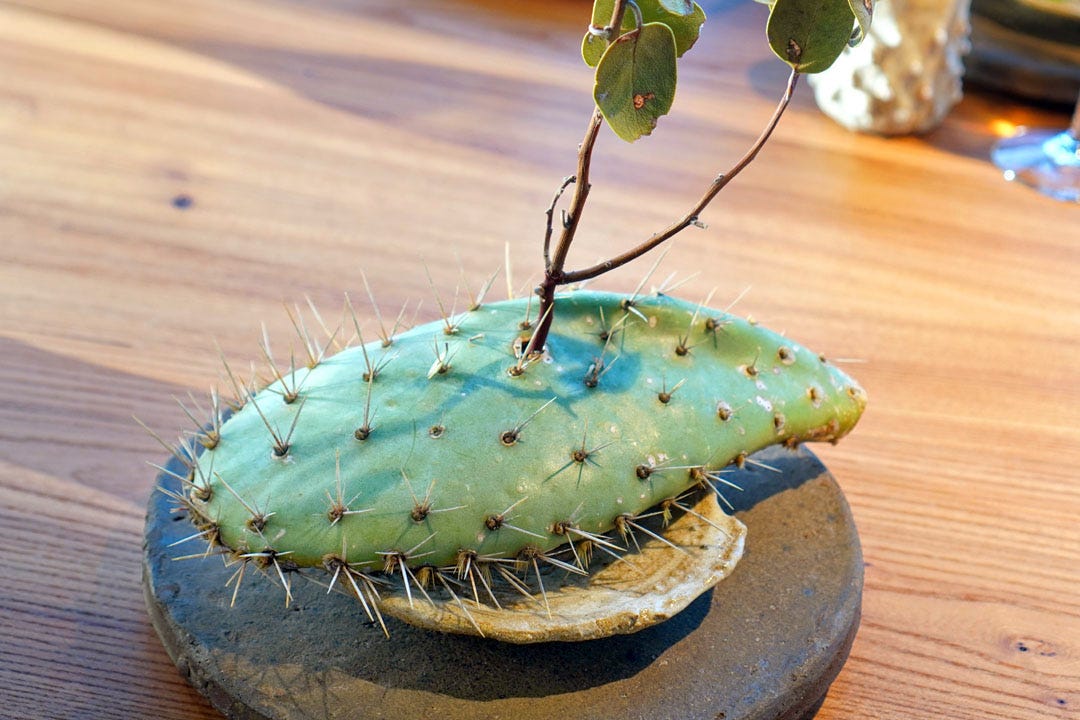
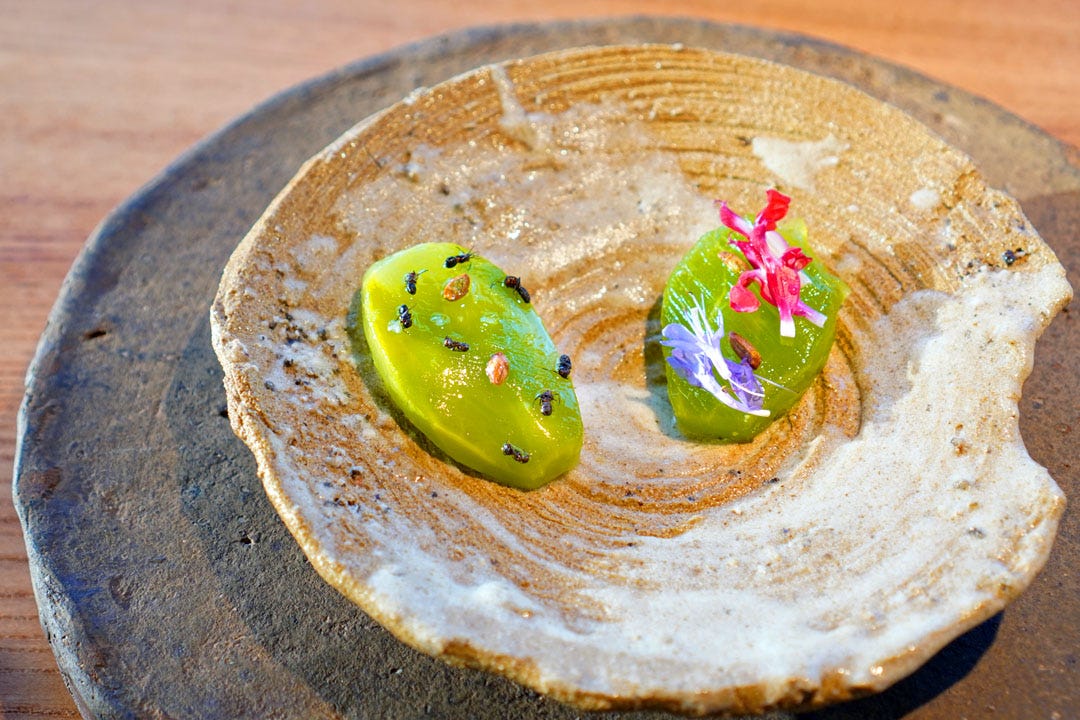
6: Cactus with Mezcal
I’ve never been particularly fond of nopales, but the preparation here genuinely surprised me. Tacinga cactus pads were nixtamalized, compressed with mezcal and white sage tea, then finished with honeypot ants for seasoning. The nixtamalization process seemed especially crucial, transforming the cactus into something slick and supple while still retaining a satisfying density and structure—without much of the mucilaginous texture typically associated with nopal.
Flavor-wise, the dish leaned bright and vibrant overall, driven by sour, vegetal notes punctuated with subtle bursts of acidity and spice from the ants.
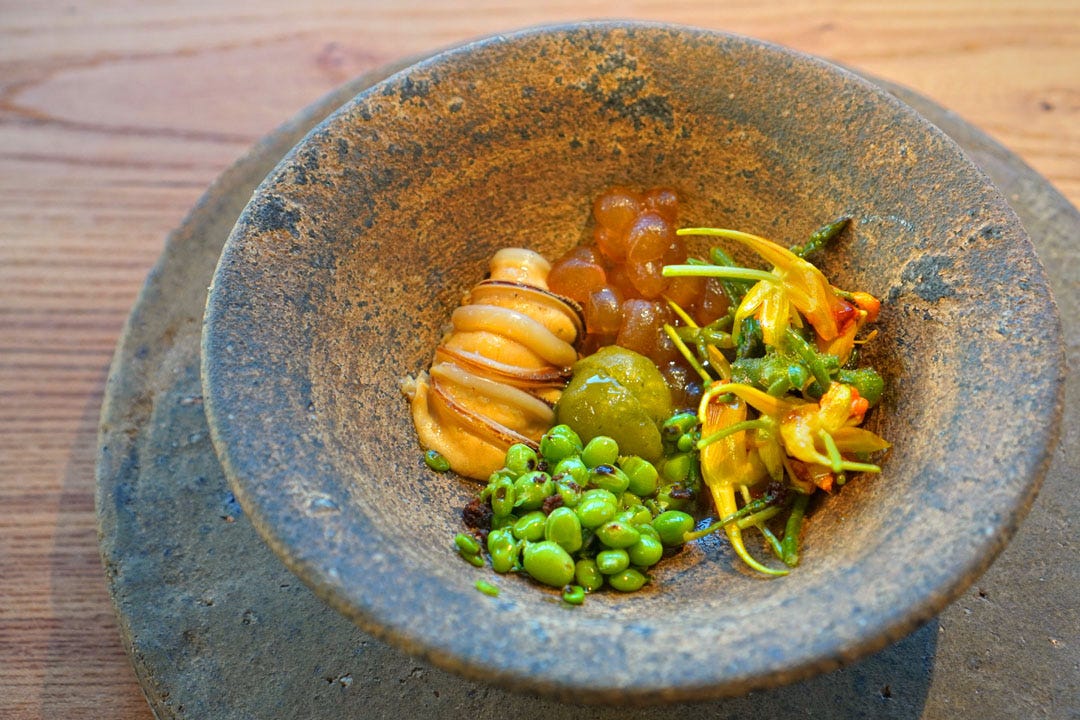
7: Ragout of Californian Botanicals
A botanical-style ragoût featuring California mussels, green tomatillo cooked with amaro, English peas, and a salad of nasturtium flowers, asparagus tips, and ice plant quickly became a favorite at the table—and understandably so. Despite the number of components involved, the dish felt remarkably cohesive, bringing together an array of bright, vegetal “green” flavors alongside smokier, deeply umami-driven elements, all subtly underscored by spice.
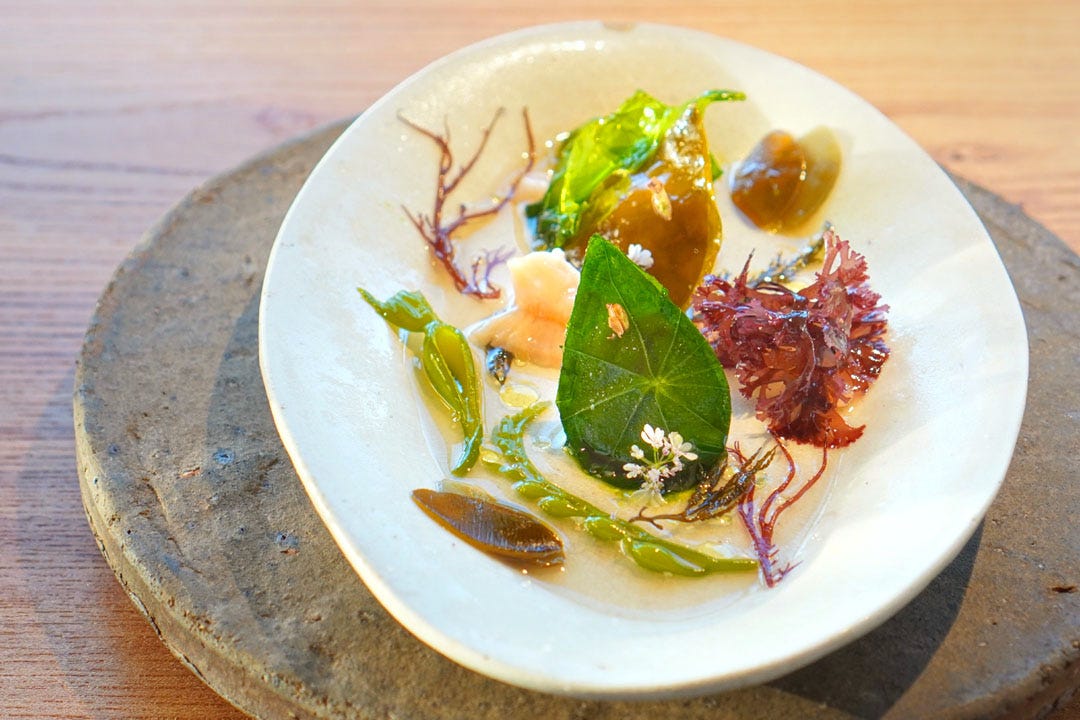
8: SoCal Seaweed and Clam
A carefully arranged assortment of Southern Californian seaweeds—kelp, sea lettuce, dulse, and others—was paired with clam and a concentrated clam broth. The dish tasted unapologetically oceanic, a full-force combination of salinity and savoriness that one of my dining companions aptly compared to the sensation of scuba diving. I also appreciated the range of textures throughout the course, particularly the contrast provided by the firm, meaty clams.
2024 Orb - Devin Alexander Myers, Elk Ridge, Mendocino
The evening’s first red wine came from Dorsal, and was made solely of Grenache from the Sierra Foothills, macerated for three days. This was definitely done in a lighter, more vivacious style, one with loads of high-toned red fruit and perky tannins, alongside a bouquet of cherry and barnyard.
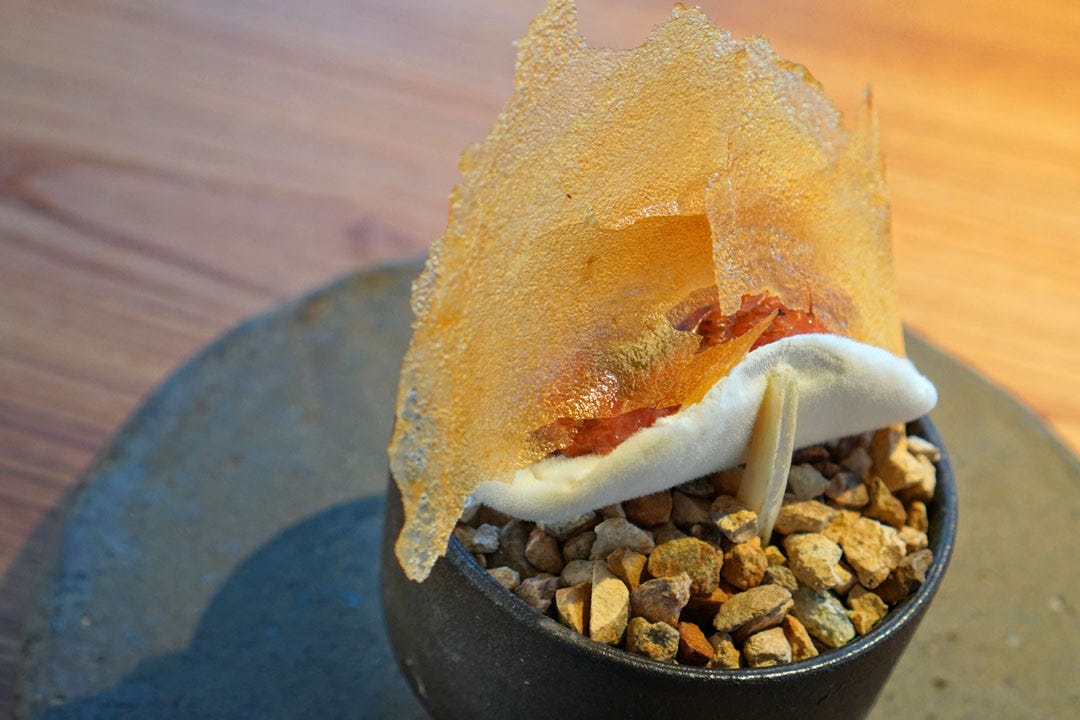
9: Tuna Neck
The first of two tuna head preparations featured a molded crêpe made from barley and rice dough inoculated with koji spores, stuffed with rich, umami-heavy cubes of tuna neck and forehead, then topped with brittle shards of dehydrated and compressed chicken broth. What stood out most, however, was the texture of the “bao” itself, which carried a distinctly fuzzy, almost leathery quality that some at the table found slightly unsettling. Even so, the unusual texture helped temper the intensity of the tuna, and I have to give the kitchen credit for creating a mouthfeel unlike anything I can recall experiencing before.
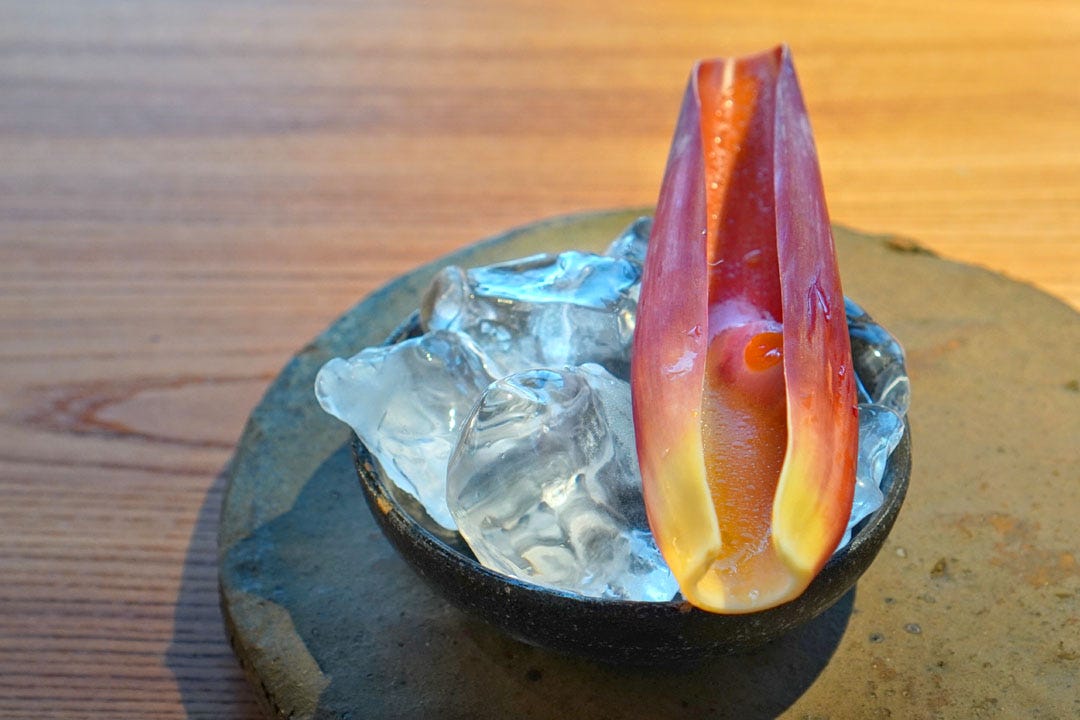
10: Tuna Eye
Another first for me arrived in the form of a collagen-rich portion of tuna eye, designed to be consumed almost like an oyster shot from within a banana flower. I was surprisingly taken by the interplay between the eye’s delicate, subtly oceanic quality and the sharper accents of bergamot juice and pungent horseradish, which helped brighten and frame the ingredient rather elegantly.
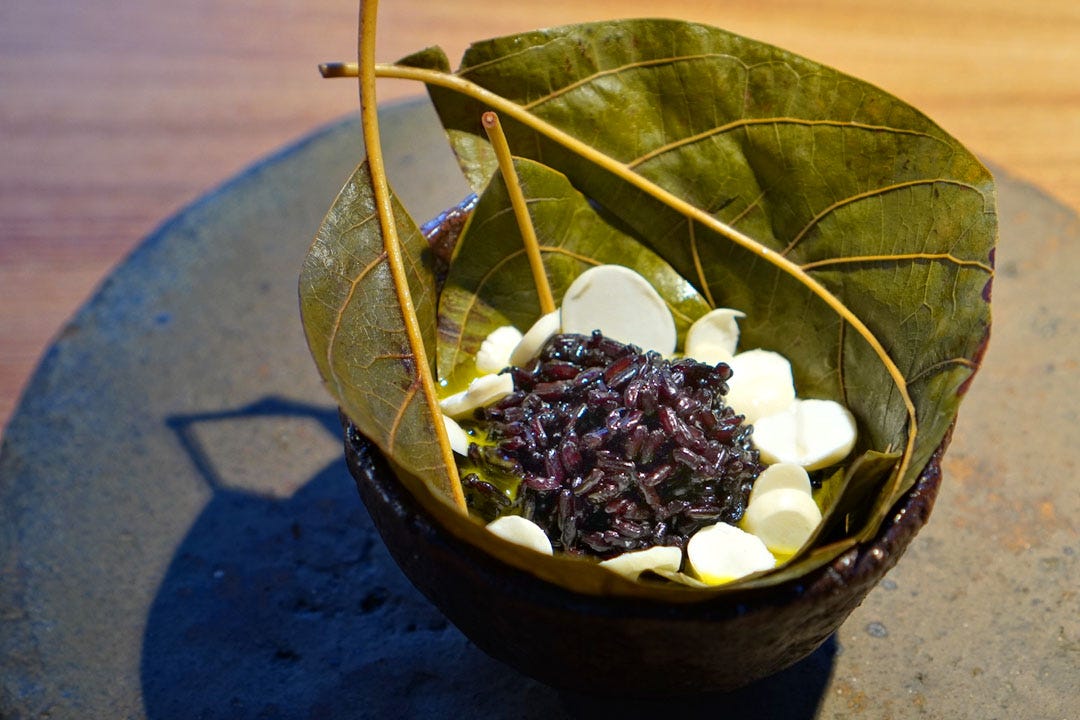
11: Black Pearl Rice Steamed with Avocado lLaf
Our first warm course featured California black forbidden rice paired with pistachio cream and surrounded by California macadamia nuts. While I appreciated the rice’s warmth, comforting texture, and properly sticky consistency, the dish overall came across noticeably more subdued than many of the preceding courses. The flavors felt fairly restrained—almost bland at points—with the nutty crunch of the macadamias and richness of the pistachio cream doing much of the heavy lifting against what ultimately tasted like relatively straightforward forbidden rice.
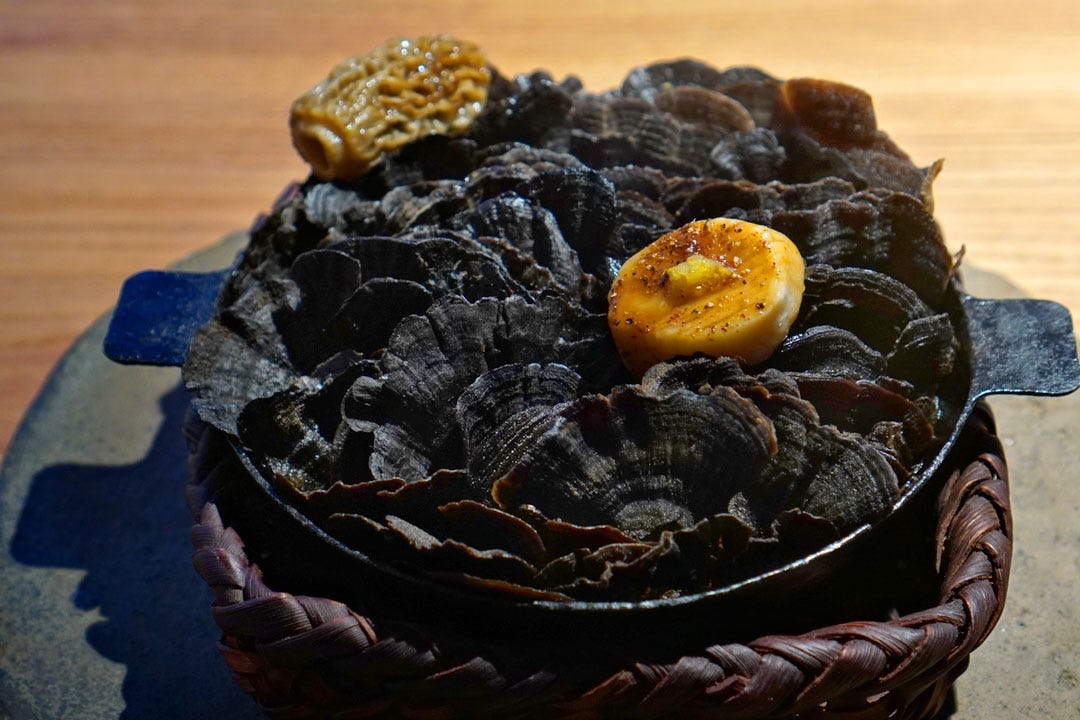
12: King Oyster and Morel Mushrooms with Habanero and Yuzu
A mushroom duo arrived atop a bed of turkey tails, seasoned with a habanero-based variation of yuzukoshō. For me, the most interesting aspect of the dish was the contrast in texture between the two mushrooms. I started with the morel, which delivered its characteristic sponginess and succulence, while the thinly scored eryngi leaned much slicker and more supple in comparison.
That said, despite the textural intrigue, the course ended up feeling somewhat underwhelming overall. Compared to the stronger and more conceptually cohesive dishes earlier in the meal, the flavors here came across flatter than expected, making the preparation feel more academically interesting than genuinely exciting to eat.
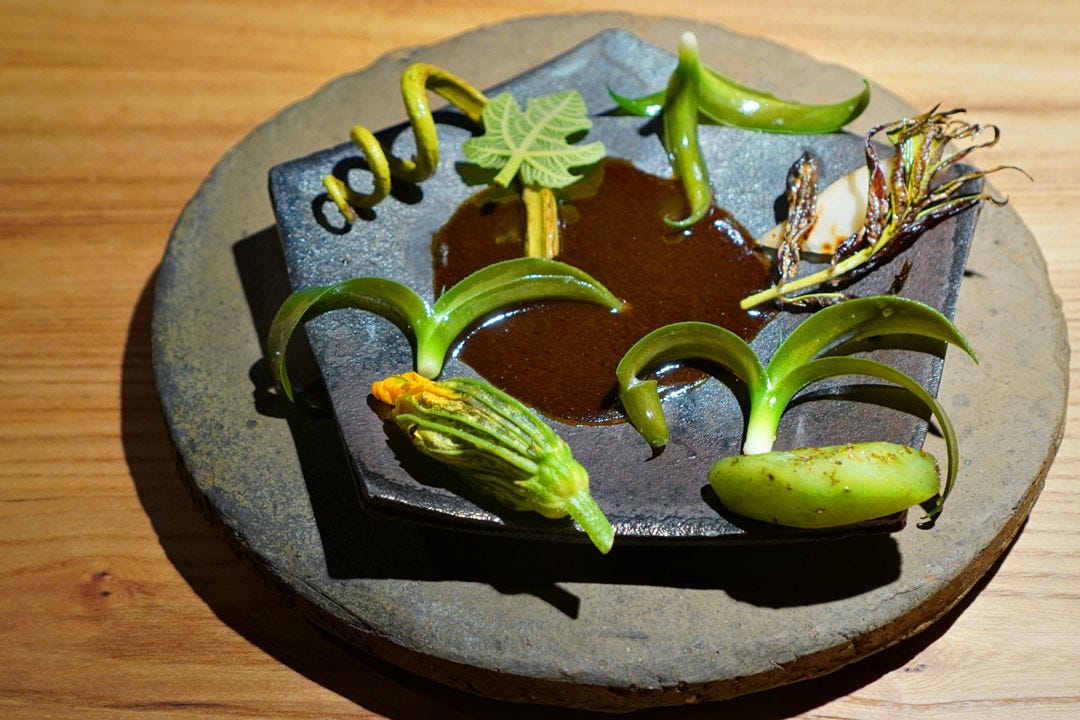
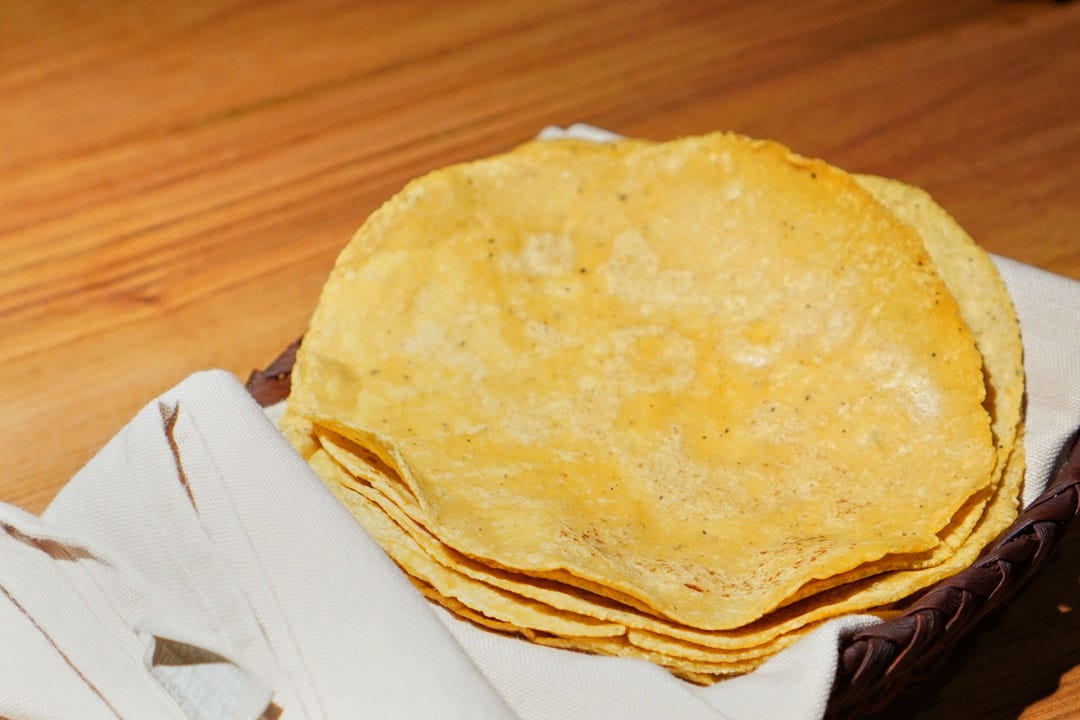
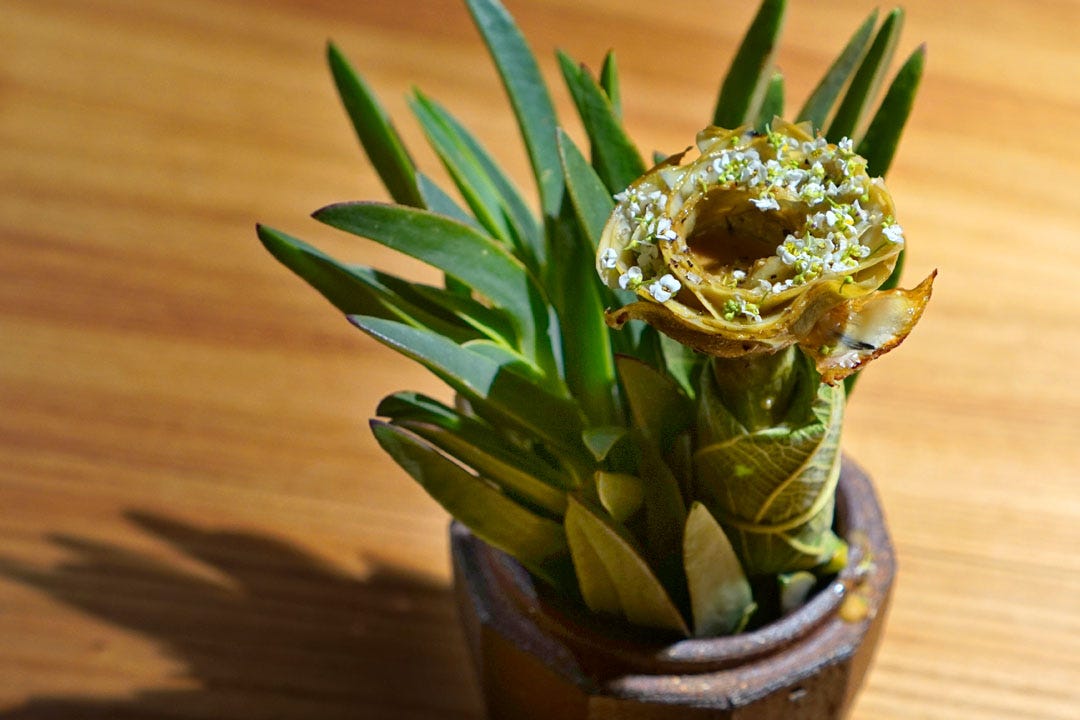
13: Seasonal Greens and Grilled Artichoke in a Spiced Kelp Mole
For the final savory course of the evening, a pentagonal plate arrived carrying an assortment of vegetation: one-year-old agave shoots, zucchini blossom, unripe cherimoya, chayote, kogomi, and fig leaf shoots, all accompanied by a sauce built from seaweed and chilies. I was impressed by how effectively the dish conveyed such a wide range of flavors—bright, bitter, smoky, sweet, and vegetal—while still remaining cohesive. Much of that cohesion came from the savory depth of the accompanying “mole,” which tied the components together beautifully (and was excellent mopped up with the accompanying floppy tortillas).
A few minutes later, the second half of the course arrived: a grilled artichoke dressed with masa butter and presented almost like a flower, with the outer leaves intentionally left attached to function as a handle. I’m generally not much of an artichoke person, but this was easily one of the stronger preparations of the ingredient I’ve had.
2025 Pasi - Riley O’Neill Latta, Pasadena, Los Angeles
To accompany dessert, we were poured a cider created specifically for the residency. Made from Northern California apples and refermented with passion fruit picked from the cidermaker’s grandparents’ backyard, the result was lively and effervescent, layered with tropical yellow fruit notes, sour beer-like funk, and a subtle barnyard quality.
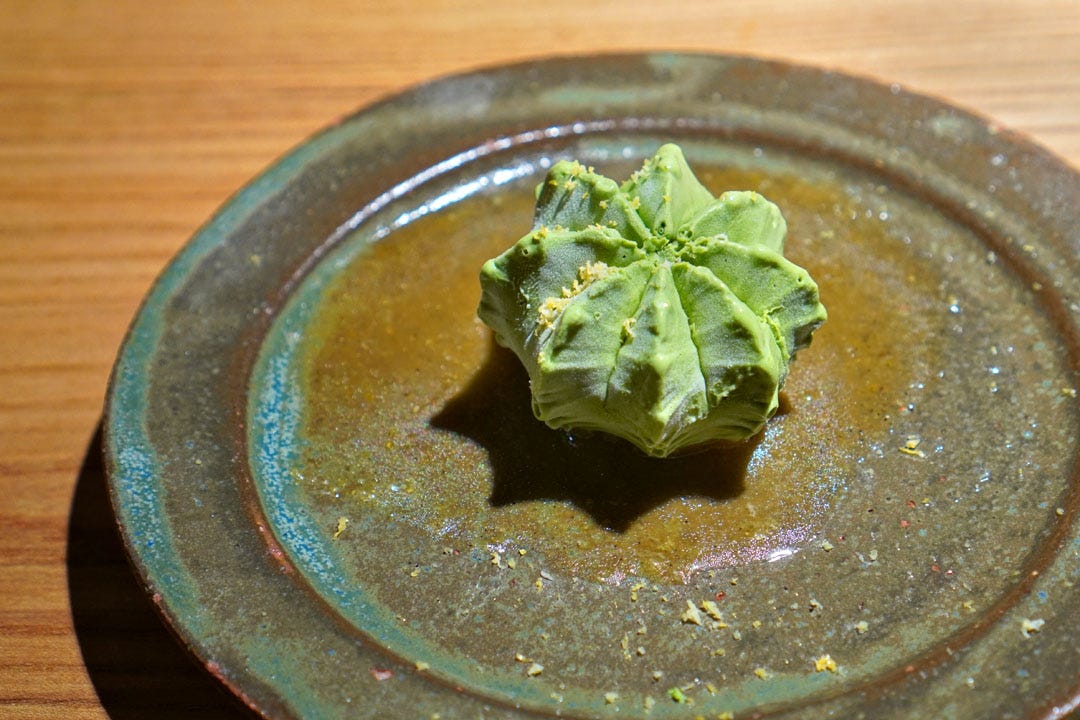
14: Dessert of Cherimoya and Lemongrass
The first dessert featured cherimoya ice cream seasoned with lemongrass, piped into a cactus-shaped matcha shell and placed atop a sauce of plum wine and saffron. I’m always impressed when a restaurant manages to make cherimoya compelling—normally one of my least favorite fruits (the textural equivalent of green sperm)—and this ended up being a genuinely lovely one-biter. The interplay between the earthy bitterness of the matcha and the gingery brightness of the lemongrass worked especially well against the fruit’s tropical custard-like base.
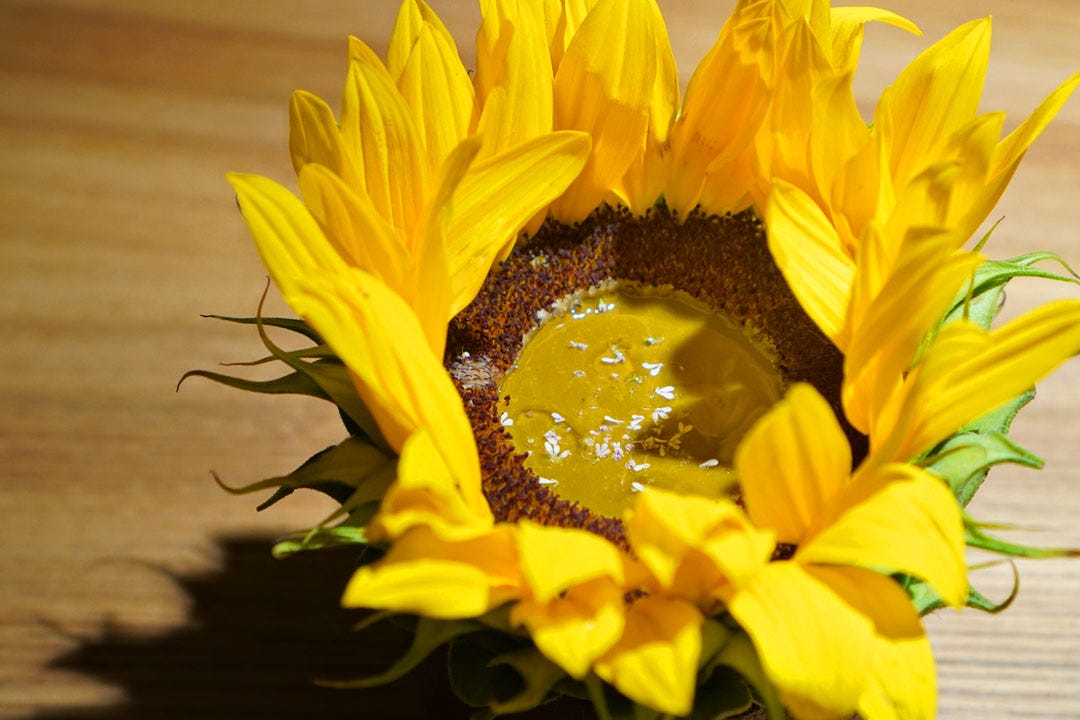
15: Macadamia Milk Custard and Pistachio
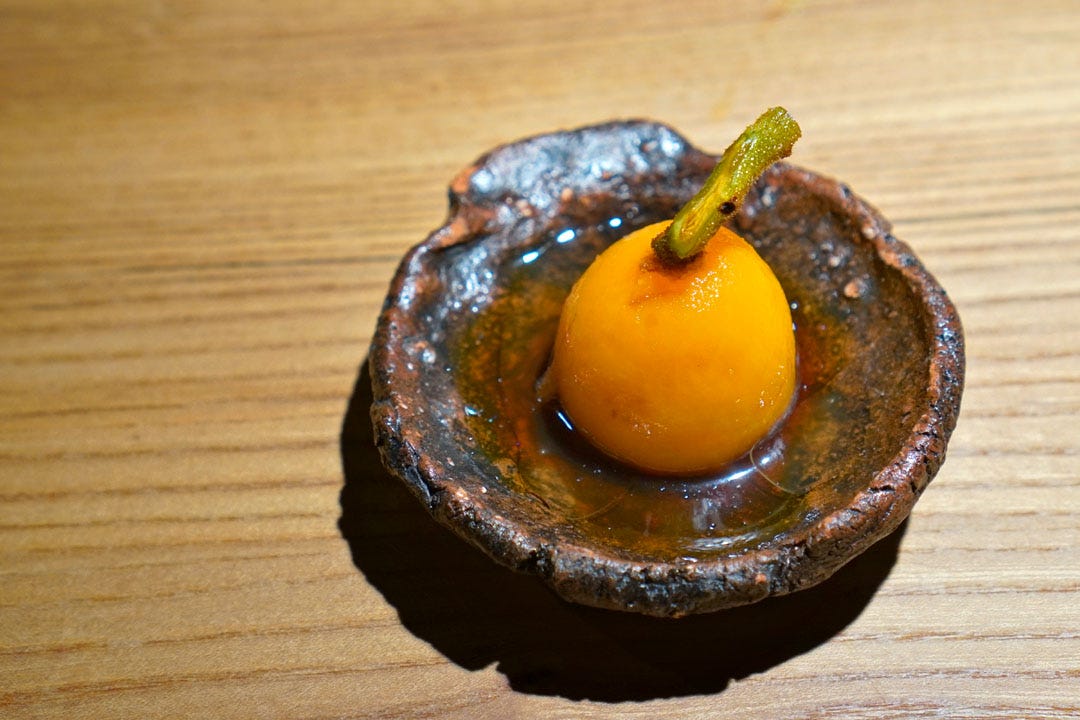
A custard made from macadamia and vanilla was topped with pistachio sauce and elderflower, resulting in a dessert that felt sweet, nutty, and quietly restrained. Alongside it came an exceptionally juicy loquat poached in oxidized wine, and it was really that poaching process—the wine’s deep nuttiness—that elevated the fruit so successfully. I’ve had plenty of loquat over the years, both fresh from my aunt’s backyard and store-bought, but this may very well have been the best single piece of the fruit I’ve eaten.
16: Silver Lake Fortune Cookie
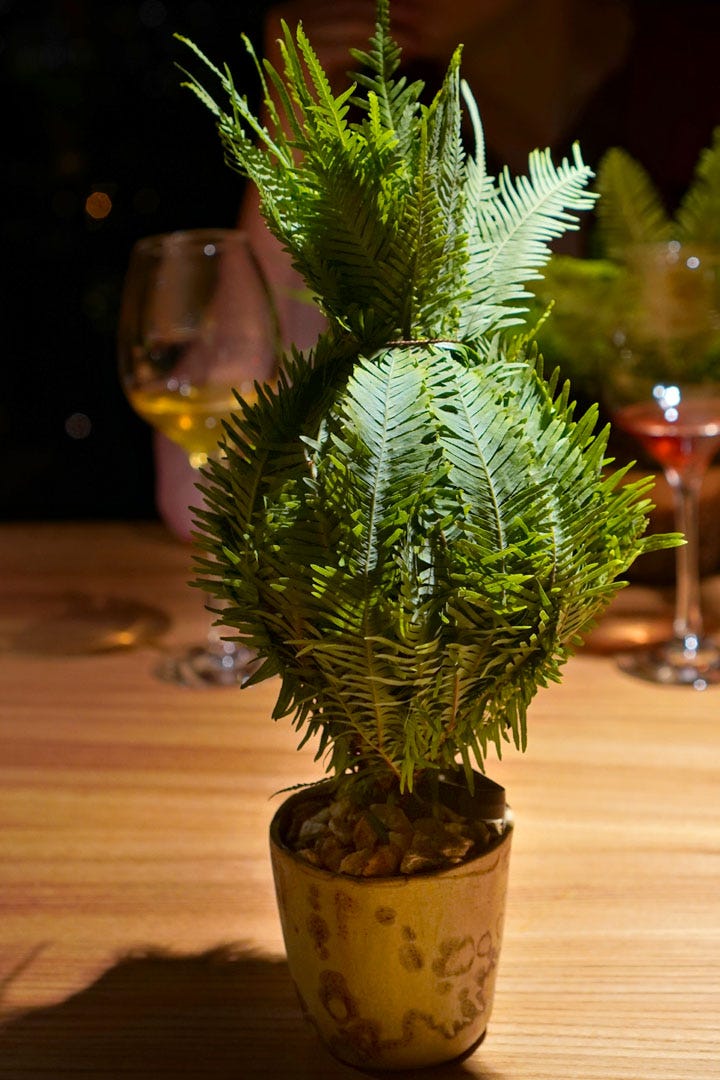
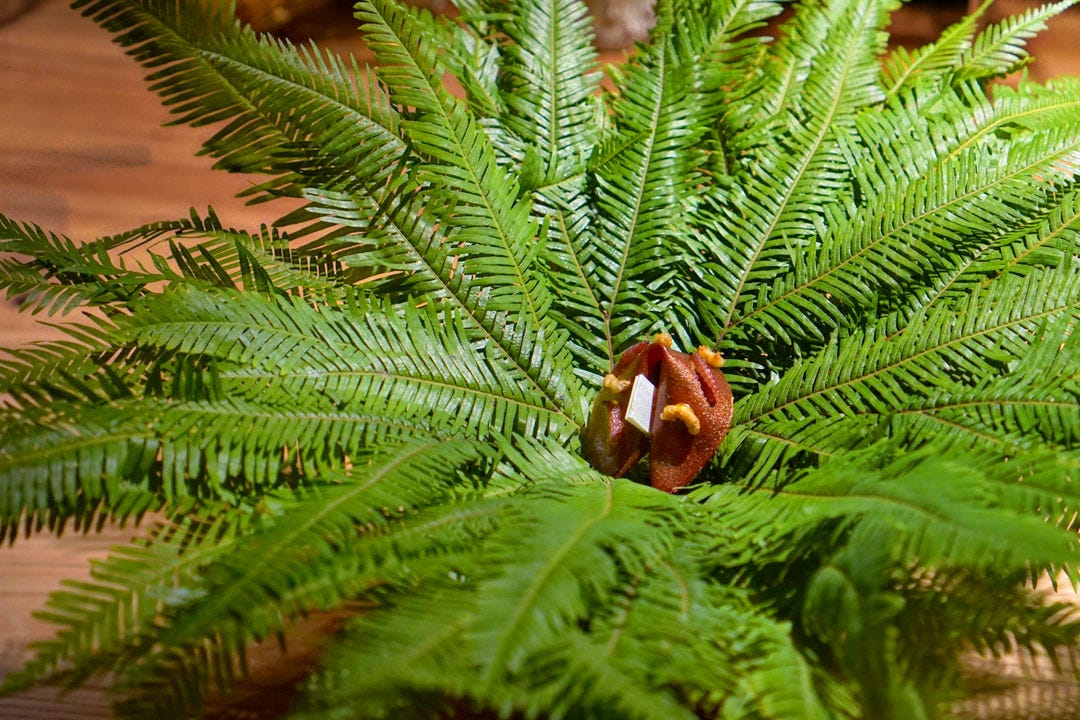
The final course arrived disguised as a miniature tree, with guests instructed to use a pair of pruning shears to cut the string binding the branches together. Inside was a savory-sweet fortune cookie composed of fruit leather, chocolate mousse, and dried strawberries, finished with bee larvae and agave worms for an extra layer of texture and earthiness.
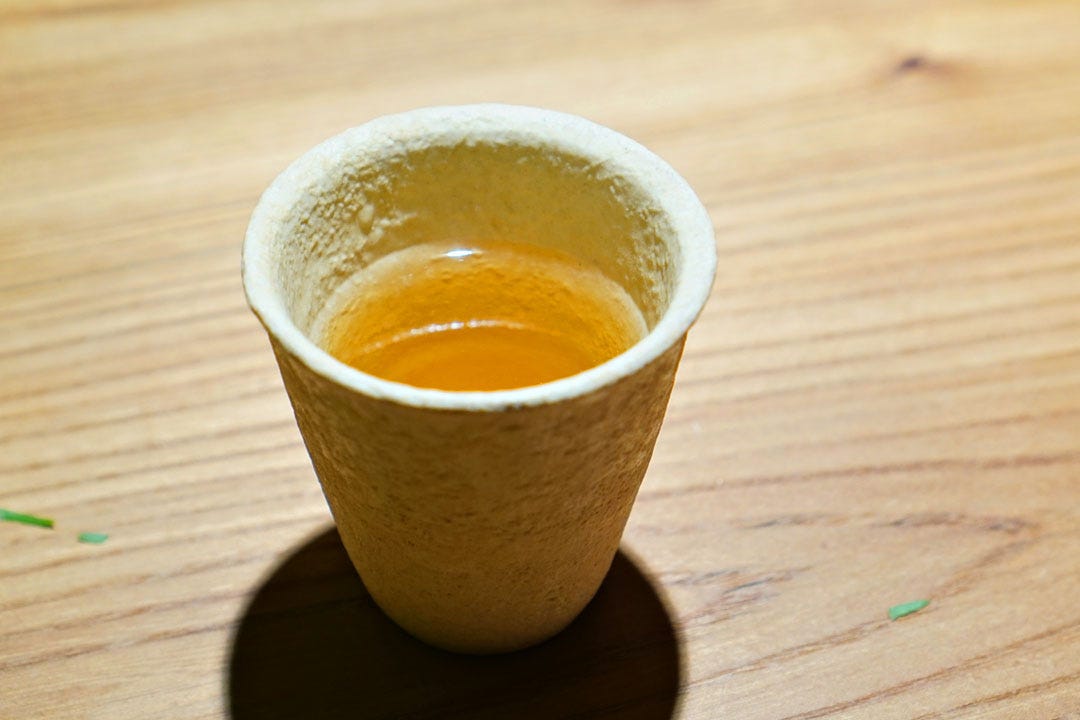
We had a choice of three herbal teas, and I ended up with this cozy lemon balm and white sage infusion.

Word.
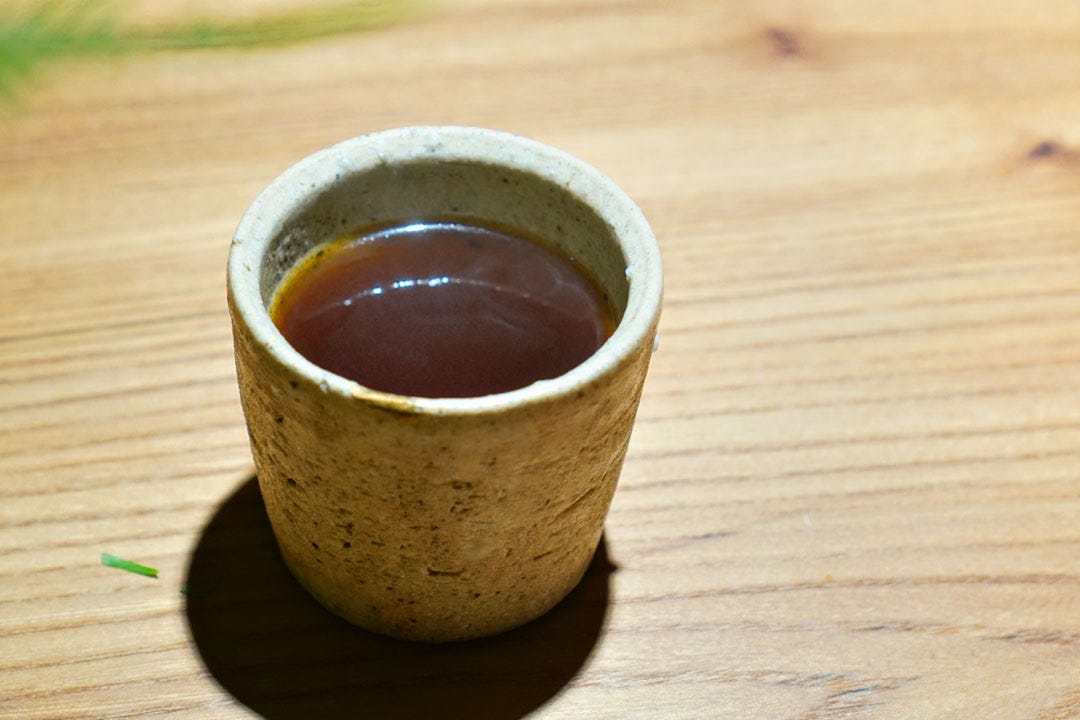
Coffee service.
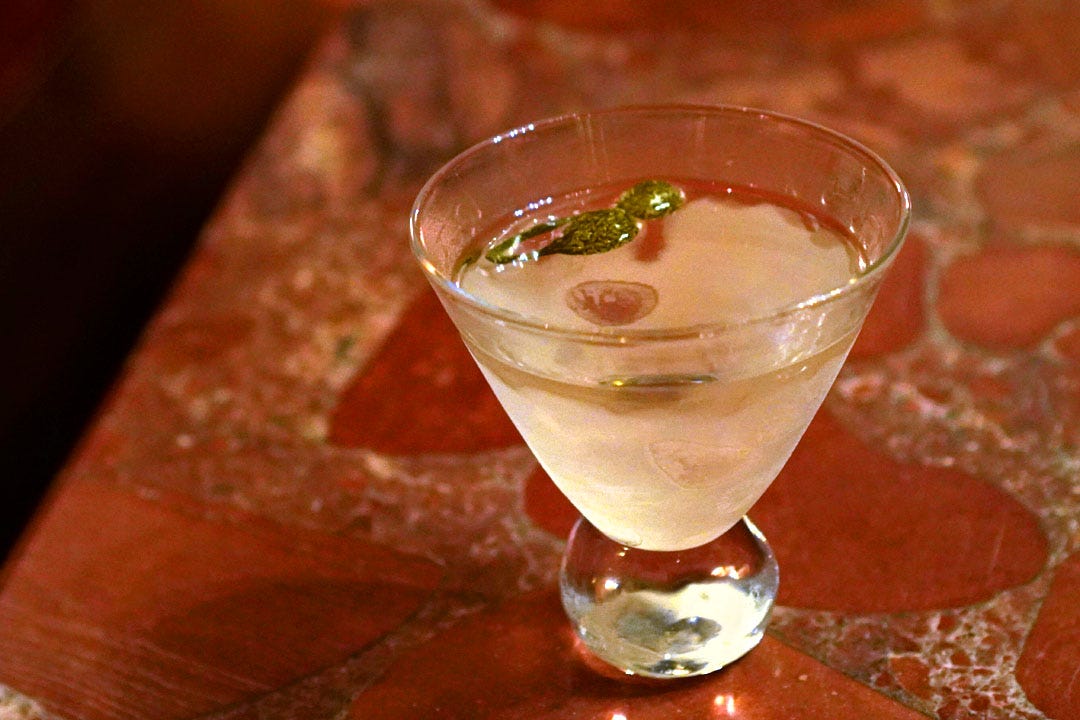
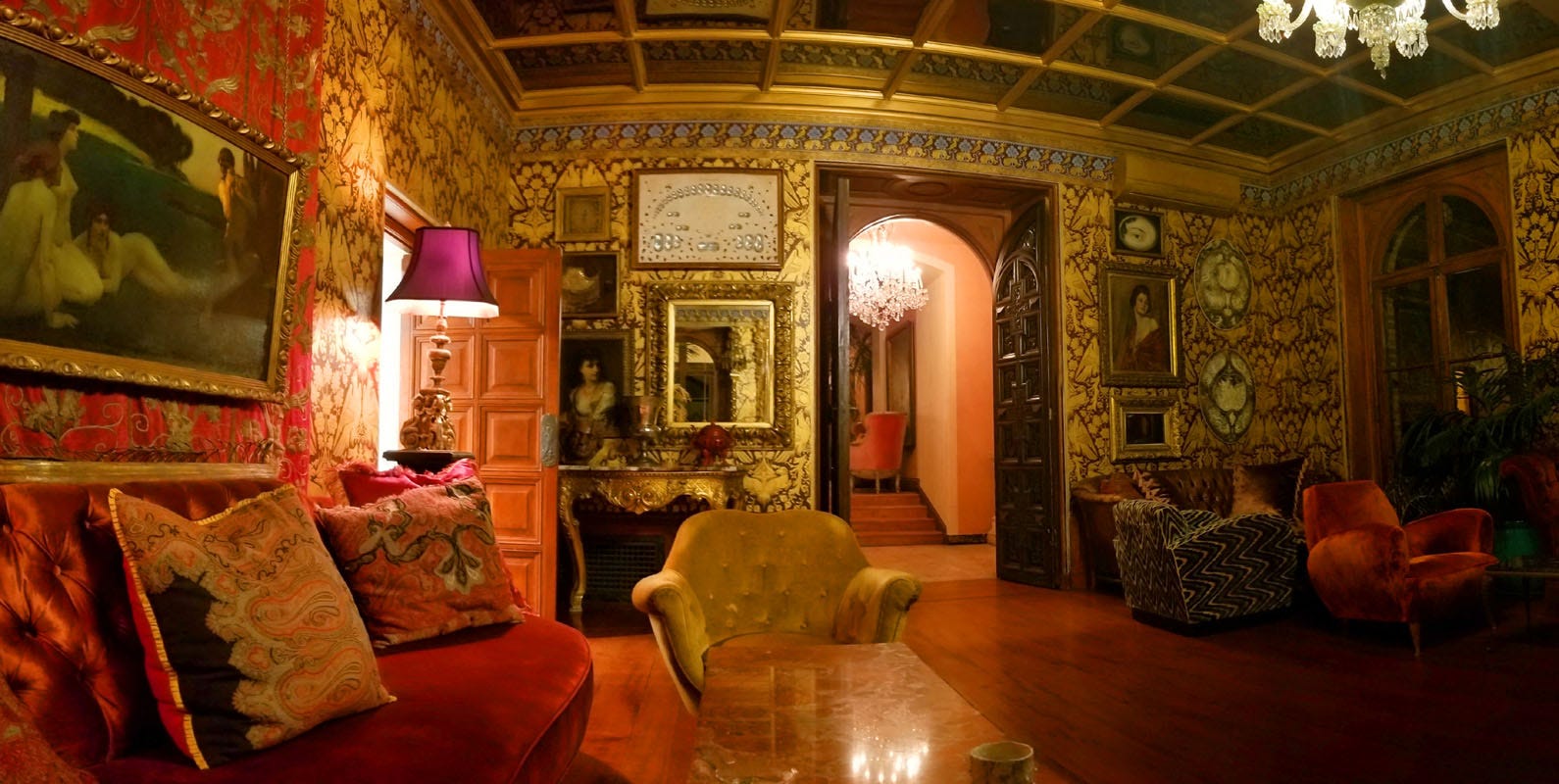
Post-dinner retirement to the salon to water the head.
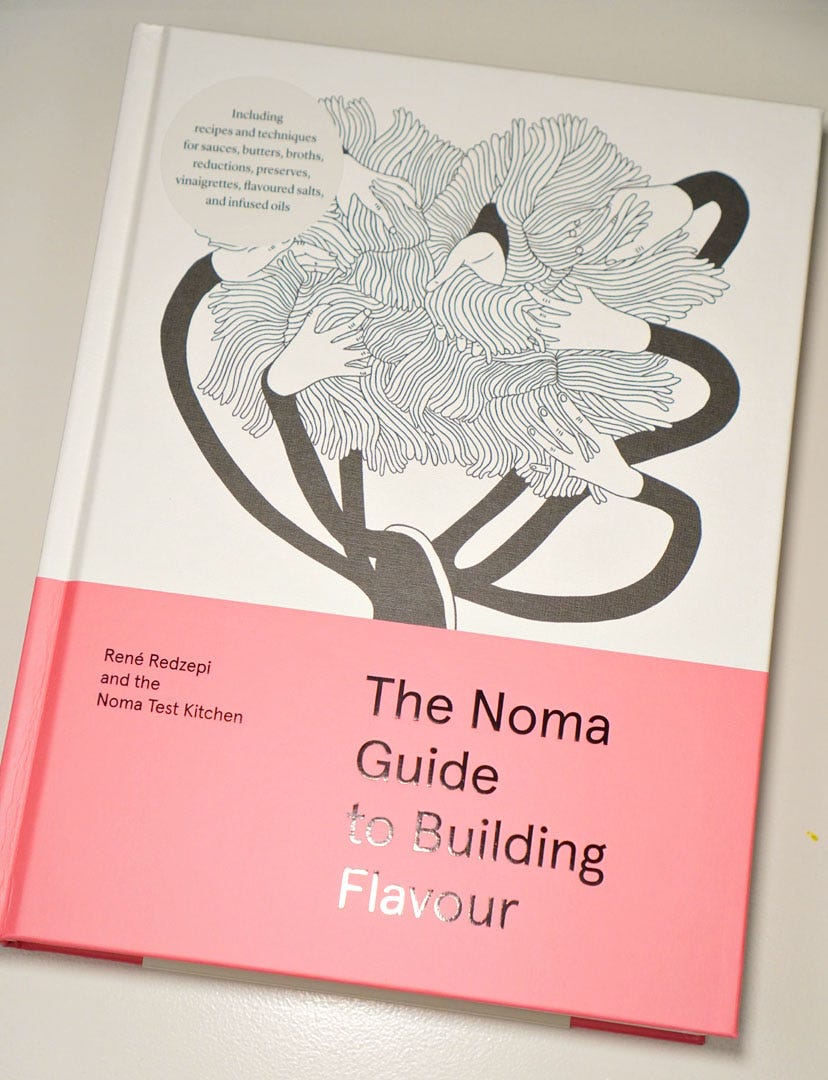
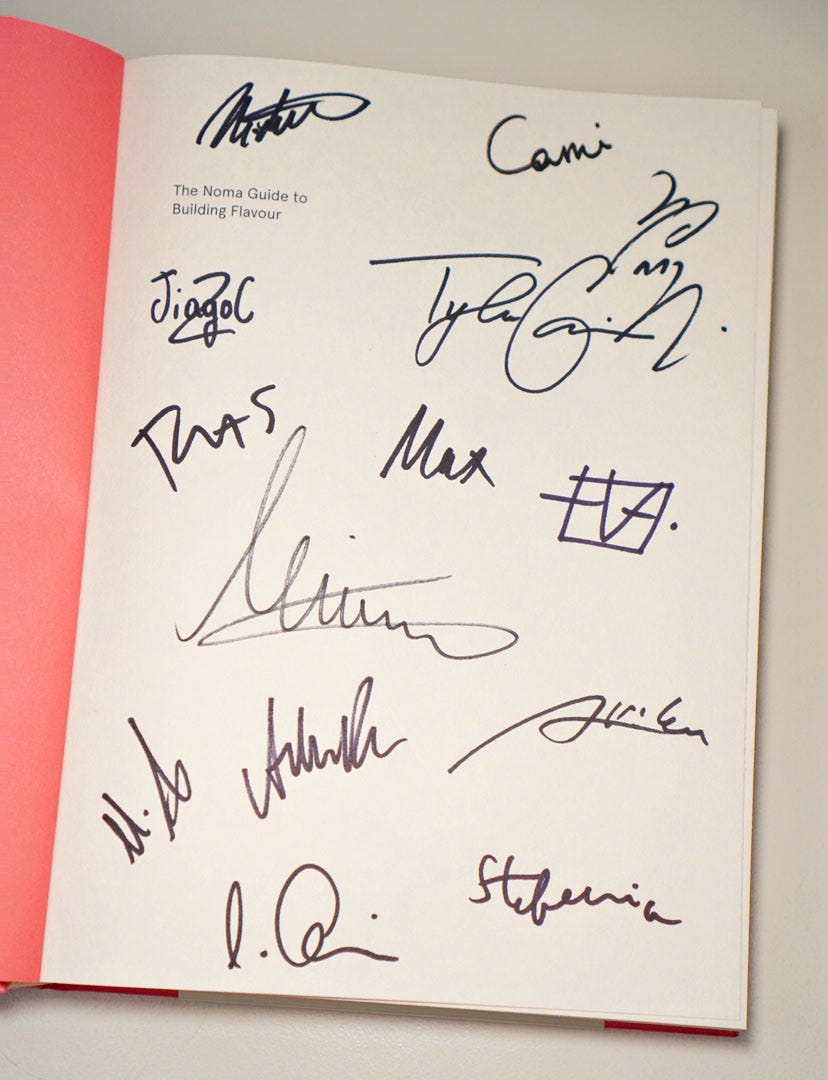
As a parting gift, I received a signed copy of the newly-released The Noma Guide to Building Flavour, which, to me, beats the cliched bag of granola or seasoning.
Attempting to create an LA version of Noma was already an inherently difficult proposition even before the controversy surrounding the residency entered the picture. Translating one of the most influential restaurants of the modern era into an entirely different ecosystem, culture, and ingredient landscape was always going to carry enormous expectations. And yet, somewhat to my surprise, the team largely managed to pull it off. They succeeded in capturing much of the original restaurant’s ethos while reshaping it to fit Southern California’s climate, produce, and overall sensibility. Much of the food aligned fairly closely with what I’d imagine “Noma in Los Angeles” should look like.
That said, the evening also reinforced the feeling that Noma may have lost a bit of its fastball. There were certainly moments of brilliance and intellectual curiosity throughout the meal, but there were also stretches where the experience drifted toward style over substance—where conceptual framing, unusual vessels, or textural experimentation occasionally felt more compelling on paper than in actual execution. Some dishes carried the unmistakable feeling of a team still trying very hard to be “Noma,” which at times bordered on self-parody in a way the original restaurant never quite did at its peak. You could occasionally sense the machinery behind the magic.
Still, I think the current wave of backlash toward the restaurant has become somewhat overstated. The internet now talks about Noma as though it were some washed-up relic surviving purely on reputation, and I don’t think that’s entirely fair either. Even in a slightly diminished state, there remains an enormous amount of creativity, technical precision, and organizational discipline on display here. Plenty of restaurants would kill to execute at this level while supposedly “past their prime.”
Following Redzepi’s departure, I have to imagine the staff endured a fair amount of uncertainty and emotional whiplash during those early weeks of service. By now though, the operation appears to have stabilized, perhaps even evolved into something more collaborative and decentralized. That probably shouldn’t come as much of a surprise. Noma has existed for over twenty years at this point, and organizations of that scale typically develop the infrastructure, personnel, and institutional knowledge necessary to survive turbulence.
Noma LA wraps up at the end of June, and after everything surrounding the residency, I’m left wondering what exactly comes next for the brand. How does the team continue forward and establish an identity that can exist beyond Redzepi’s shadow—both his influence and now his notoriety? Especially considering that Noma no longer really functions as a traditional restaurant anymore, instead operating more as a culinary R&D lab, product incubator, and traveling residency concept. There are some genuinely difficult questions hanging over the future of the organization, and I’m not entirely sure anyone—including Noma itself—fully knows the answers yet.