

Full Time Aura Farming
The 5 Japanese Philosophies to Set You Free + The Desserts I'm Making All Spring

I was standing at work one day, completely detached from whatever was happening in front of me. My eyes were fixed on the screen, but nothing was registering. It was one of those moments where your body is physically present, but your mind has drifted somewhere far outside the room.
Amidst a haze of Reddit posts, getaway day MLB.TV at 11:00 A.M., I came across this.
I was stimulated. It was an article about Japanese philosophy—Kaizen, Ikigai —concepts I had never encountered before. I ended up reading the entire thing under the desk while my boss was eerily leering over my shoulder, and somewhere during those few minutes, something subtly shifted in me. Quietly. Almost imperceptibly. The kind of shift that changes the trajectory of your thinking before you even realize it’s happening.
From there, I started digging deeper. One article turned into another. One idea led to an entirely different framework. Before long, I found myself immersed in philosophies that people in Japan had been practicing for centuries. The more I read, the more I realized these weren’t abstract ideas meant only for scholars or monks. They were deeply practical principles for living. Timeless observations about discipline, meaning, purpose, identity, and growth. More importantly, they were immediately applicable to the exact things I was dealing with at the time.
This isn’t a breakdown of every Japanese philosophy I’ve come across, but rather the handful that fundamentally changed the way I operate.
As I write this, it’s 11:35 a.m. Black coffee is steaming on the desk beside me. Before I even take a sip, the smell hits first—that familiar warmth that quietly signals to the brain that the day has begun, albeit a watered-down version as the office cup pails in comparison to that Sunday morning one. The sun is coming through the window. Birds Construction trucks are making noise outside. Nature’s version of an alarm clock.
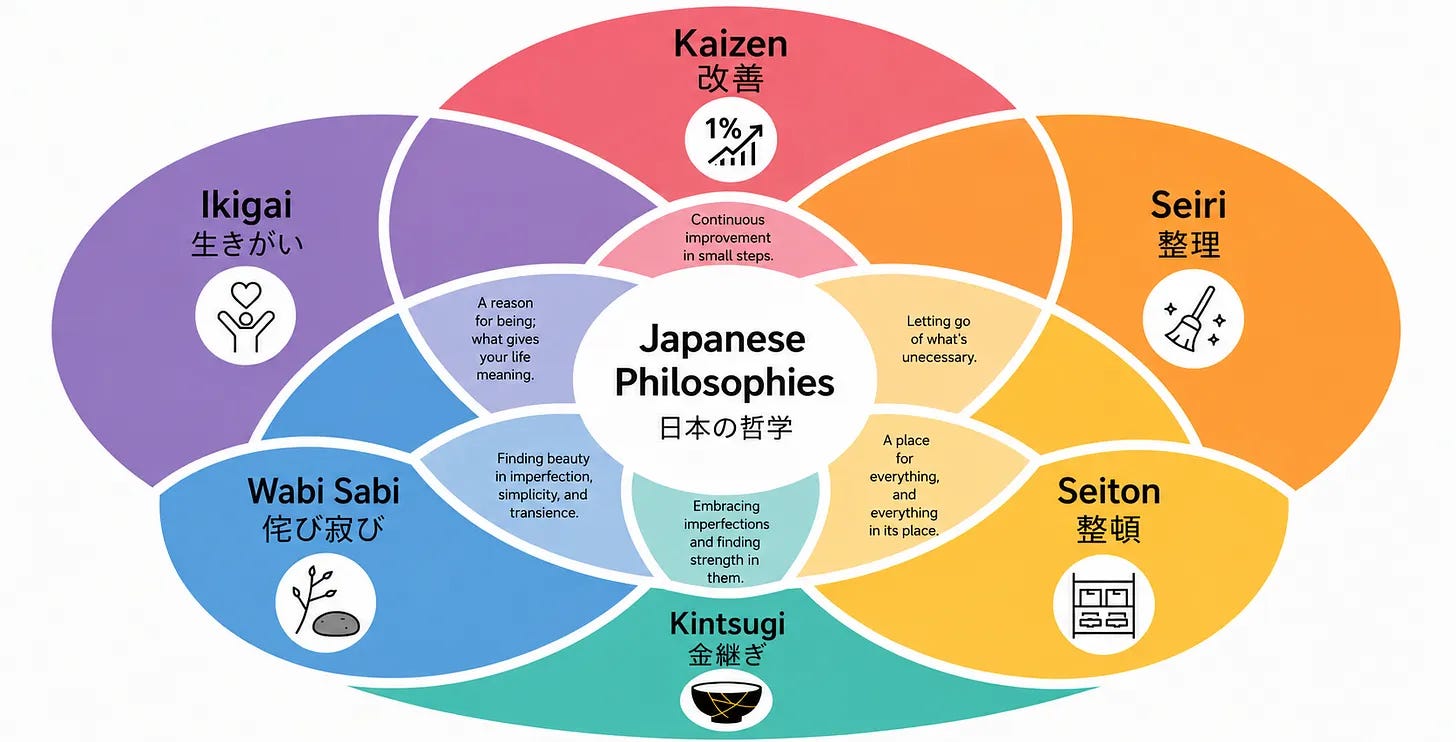
So let’s get into it.
KAIZEN — 改善
“Beginning is easy, continuing is hard.” — Japanese proverb
Kaizen translates to continuous improvement.
Simple in theory, profound in practice.
At its core, the philosophy revolves around the idea of improving by just 1% every single day. You’ve probably seen the mathematics before: 1.01 raised to the power of 365 equals roughly 37.8. Nearly thirty-eight times better over the course of a year through small, incremental progress. Meanwhile, 1.00 raised to the power of 365 remains exactly one. No growth. No compounding. Just stagnation disguised as stability.
And stagnation rarely announces itself dramatically. It creeps in quietly. One unchanged day at a time until eventually you wake up and realize the person standing in the mirror is almost identical to who you were years ago.
Kaizen can completely reshape the way you approach growth because it aligns so naturally with how the brain actually changes. Neuroscience refers to this through neuroplasticity—the brain’s ability to strengthen and reorganize neural pathways through repetition. Small, repeated actions gradually become automatic behaviors. Over time, those repeated behaviors stop feeling like effort and start becoming identity.
The issue is that most people drastically overestimate how quickly transformation should happen while simultaneously underestimating the long-term power of consistency.
Take reading as an example. Someone decides they want to become a reader, so they immediately commit to a chapter a day because it sounds ambitious and productive. In reality, that target is often too aggressive for someone building the habit from zero.
What works far better is starting absurdly small. One page a day. Genuinely.
Because the goal during the first week isn’t to consume information—it’s to create the identity of someone who returns to the book every day. One page becomes two. Two becomes three. Months later, the person reading a few pages consistently surpasses the person who sprinted toward an unrealistic target and burned out almost immediately.
The same principle exists in fitness through progressive overload. The body adapts gradually. You increase the weight or volume slowly as the current load becomes manageable. Human behavior operates the same way.
Apply this concept everywhere: writing, fitness, business, relationships, learning, and discipline.
Small. Consistent. Compounding.
That’s how transformation actually happens.
IKIGAI — 生き甲斐
Ikigai roughly translates to “a reason for living.”
The framework sits at the intersection of four questions:
What do you love?
What are you good at?
What does the world need?
What can you be paid for?
Where those four things overlap is your Ikigai—your reason for being.
Psychologically, human beings are not wired purely for consumption. We need meaning. We need contribution. We need the feeling that our existence creates something valuable outside of ourselves.
Research surrounding purpose and fulfillment consistently points toward the same conclusions: people with a strong sense of meaning tend to experience greater life satisfaction, lower rates of depression and anxiety, stronger resilience, and even improved longevity.
There’s a reason Okinawa, Japan—home to one of the highest concentrations of centenarians in the world—is so frequently studied in relation to Ikigai. People who possess a clear sense of purpose often remain psychologically and physically healthier for longer.
Recently, I have been teetering on the idea of what I truly want in life. The only thing I knew with certainty was that the traditional path—the 9-5, working corporate ladder, the repetitive trade of time for money—felt deeply misaligned with who I was. With so much to do, so many places to see, why limit myself to the shackles of Vegas?
But knowing what you don’t want only gives you half the answer.
Ikigai helped me compartmentalize these thoughts.
When I sat honestly with those four questions, patterns began emerging.
I loved learning. Challenges. Diving deeply into ideas until they transformed the way I understood myself and the world around me.
I was naturally good at discovering new concepts and translating them into something understandable.
The world clearly needed people capable of creating and disseminating taste with a cultured world view.
And eventually I am realizing that teaching and communicating those ideas could also become financially viable (still working on it).
The important thing, though, is that not every answer appears immediately. Some have to be built over time rather than discovered instantly. Ikigai isn’t something most people magically stumble upon one afternoon. It’s something constructed through experimentation, iteration, and self-awareness.
If you don’t know your Ikigai yet, start with what genuinely excites you and what comes naturally to you. The rest tends to reveal itself gradually.
SEIRI & SEITON — 整理 と 整頓
“When you tidy your space, you also tidy your mind.” — Marie Kondo
Seiri and Seiton are the first two principles within the Japanese 5S organizational system.
Seiri means removing what no longer belongs.
Seiton means organizing what remains.
What fascinated me most about these ideas was not the organizational aspect itself, but the neurological impact of physical environment on mental clarity.
Your surroundings are not neutral.
A cluttered room creates what neuroscientists refer to as environmental visual noise. Even when you aren’t consciously paying attention to it, your brain is continuously processing the unfinished tasks, misplaced objects, and disorganization surrounding you.
That constant low-level cognitive processing drains the same mental resources required for focus, creativity, and sustained attention.
Research consistently shows that cluttered spaces elevate cortisol levels—the body’s primary stress hormone. Over time, elevated cortisol contributes to anxiety, impaired cognition, and mental fatigue.
A clean environment creates the opposite effect.
Your nervous system relaxes. Your brain stops wasting energy processing disorder.
Personally, I started implementing this through extremely simple habits. Wiping down my entire kitchen counter every night and putting up dishes. Mopping my space every Sunday.
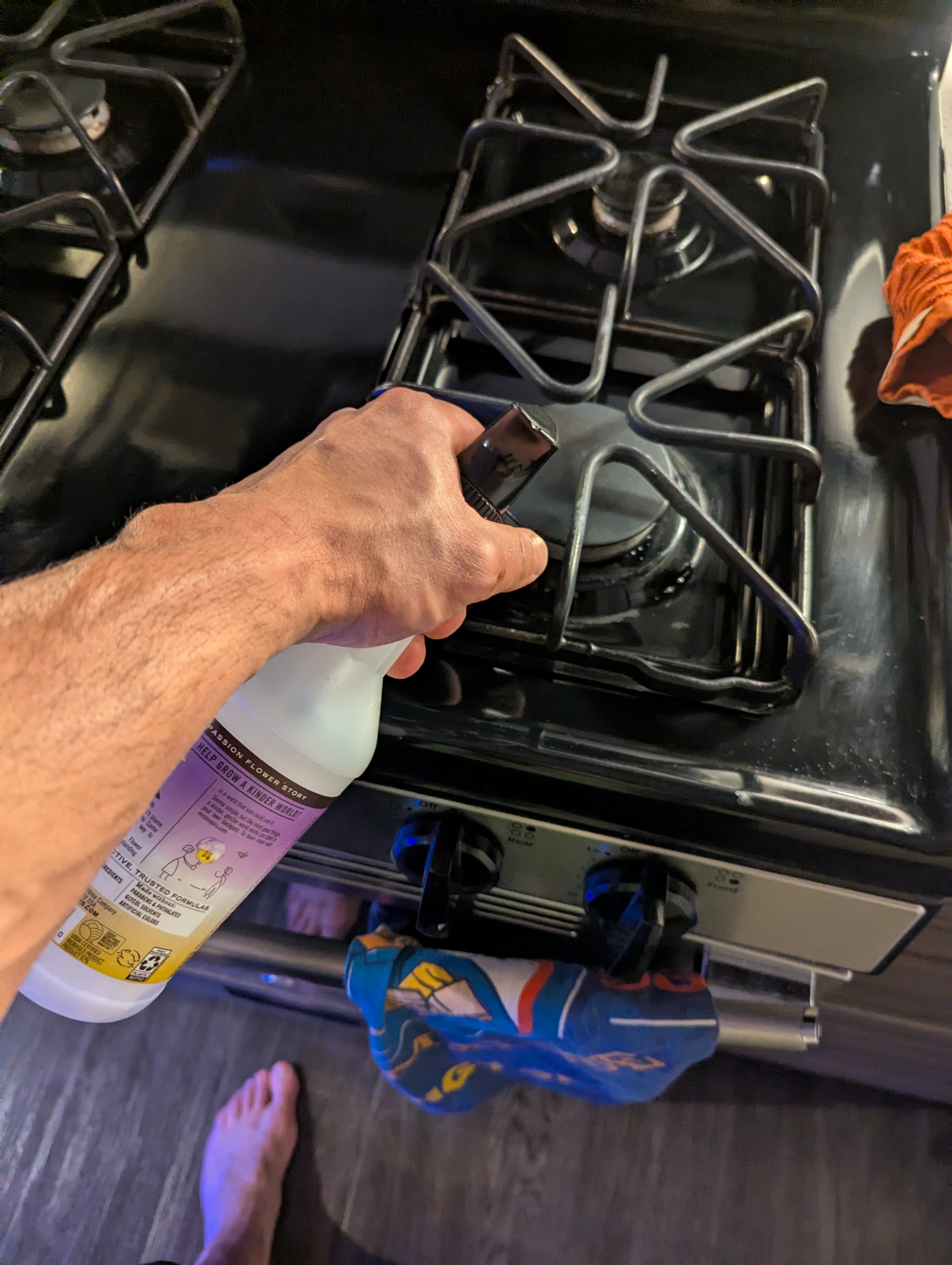
These practices sound basic because they are basic. But foundational habits are often embarrassingly simple.
Clean your room. Put things back where they belong. Remove unnecessary visual chaos.
Then sit quietly in the space afterward.
You’ll feel the difference almost immediately.
KINTSUGI — 金継ぎ
Kintsugi is the Japanese art of repairing broken pottery with gold.
Instead of hiding the cracks, the cracks are emphasized. Highlighted. Turned into part of the object’s beauty.
Most people spend enormous amounts of energy attempting to hide their flaws, failures, and fractures. Kintsugi suggests the opposite: the broken parts are often the most meaningful parts.
Psychologically, perfectionism is often misunderstood as discipline or high standards, when in reality it’s usually rooted in fear. Fear of failure. Fear of judgment. Fear of imperfection.
Ironically, perfectionism frequently leads to procrastination, anxiety, and lower performance because people become paralyzed waiting for ideal conditions.
I used to approach my routines this way constantly. If one part of my schedule fell apart, I mentally discarded the entire day. Miss my 5’oclock sauna session? Suddenly the whole routine felt out of wack.
Which, looking back, is a form of stubbornness that is conditioned in me that I have tried to change.
Missing one step doesn’t destroy progress. Deciding that progress is destroyed does.
Kintsugi is closest to Buddhist ideals and in recognizing that imperfect continuation is infinitely more valuable than perfect abandonment.
The scuffed kicks still function. It still is a house for your feeet.
And often, the creases and lived-in elements of the shoe become the most beautiful part of the piece.
WABI-SABI — 侘び寂び
“Even monkeys fall from trees.” — Japanese proverb
Wabi-sabi is the acceptance of imperfection, impermanence, and incompleteness.

Still need these Wabi-Sabi Air Maxes
Where Kintsugi finds beauty in brokenness, Wabi-sabi finds beauty in unfinishedness.
The rough edge. The fading paint. The unresolved process.
Its practical application is simple but uncomfortable:
Start before you feel ready.
The perfect moment does not exist. The perfect conditions are not arriving. The perfect version of yourself isn’t going to suddenly appear one morning fully prepared to begin.What exists is the present moment and whatever tools, knowledge, and energy you currently possess.
Action changes the brain in ways planning never can. Neurologically, movement creates learning. Execution creates clarity. Endless overthinking does not. The imperfect beginning builds the groundwork that the perfect plan only fantasizes about.
Start now. Start incomplete. Start imperfectly, risk it for the biscuit.
That’s how momentum is created.
Putting It All Together
What makes these philosophies so powerful is that they align with human nature rather than fighting against it.
Kaizen teaches consistent improvement.
Ikigai teaches meaningful direction.
Seiri and Seiton teach environmental clarity.
Kintsugi teaches acceptance of fracture.
Wabi-sabi teaches the beauty of imperfection.
Ancient frameworks. Simple concepts. Surprisingly difficult to practice consistently.
There’s another Japanese concept called Shu-Ha-Ri, the three stages of mastery:
Shu — follow the rule.
Ha — break the rule.
Ri — become the rule.
And a Chinese concept of 天地人:
天 (Heaven): Mastering Timing
Life follows power law distributions—most of your efforts will lead nowhere, while a small percentage create disproportionate impact. You don’t need to be right all the time. You just need a few shots to hit massively.
The challenge is that timing is nearly impossible to predict logically. The best opportunities tend to feel like they’re pulling you forward. Your intuition says yes before your mind can explain why. Momentum becomes obvious. Energy compounds daily. Success in that moment also creates leverage, opening doors to larger opportunities later.
When timing aligns, you stop forcing things. The momentum becomes contagious.
地 (Earth): Being in the Right Environment
While you can’t fully control timing, you can control positioning.
Your environment determines what opportunities you can even see. Geography, industry, and ecosystem matter because they place you closer to emerging waves before everyone else notices them.
That’s why innovation hubs and high-growth industries tend to produce outsized opportunities. The same idea executed in the right environment can create completely different outcomes.
But even if you’re not in the ideal place yet, momentum still matters. Small experiments, relationships, and consistent action create leverage over time. The “red paperclip principle” proves you can often trade your way into bigger opportunities through persistence and momentum alone.
The periods between major opportunities matter just as much as the opportunities themselves. Use them to build relationships, sharpen skills, and position yourself for when the next wave arrives.
And when the rocket ship finally shows up, you don’t hesitate over whether you’re fully prepared—you just get on.
人 (Person): Building with People
An average team can succeed with the right timing and market, while an exceptional team can fail solving the wrong problem at the wrong time.
That doesn’t mean people don’t matter. Great teams are simply better at adapting, recognizing shifts, and creating opportunities through persistence and vision.
If you can only optimize two of the three—timing, place, or people—prioritize timing and place first.
Still, culture matters. You don’t need the smartest team in the world, but you do want people with conviction, adaptability, and good energy around you.
Ultimately, skills and relationships matter because they improve your ability to recognize the right moment and execute when it finally arrives.
At first, these philosophies feel external. You consciously practice them. You remind yourself to implement them.
But eventually, if practiced long enough, they stop feeling like philosophies at all.
They simply become the way you operate.
There’s a reason why these ancient texts (along with Greek Stoicism) resonate so deeply in today’s muddled society. They are ideas that work and relate to the modern man/woman.

4 Things:
1. Vegas is Cool(er) Now?
After more than two years of living in Vegas, I feel like I’ve finally turned a corner in appreciating all of its strange quirks and eccentricities. Being guest-listed nightly and getting into electronic shows for free certainly doesn’t hurt either. In no other city I’ve lived in can a night out feel like such a proverbial dice roll.
The randomness of the people you meet, the spontaneous conversations, the hookups, the bizarre interactions—all of it feels impossible to predict (which can admittedly be both a blessing and a detriment).
Take last Friday night, for example. Before grabbing sushi, I had an interaction with this guy:
Keep Austin Weird? Not a proper slogan. Keep Vegas odd.
2. Two Must-Try Recipes:
Rabbit holes. Speaking of rabbit holes. During the process of cooking up this article I ventured to my pantry to find not one but three bottles of different chili crisp, and adjacent to these bottles was a brick of halva. The intersection of Middle Eastern desserts, Eastern philosophies and chili crisp made me want to create a Sichuan Hot Honey Baklava. Recipe is as follows:
Sichuan Hot Honey Baklava:
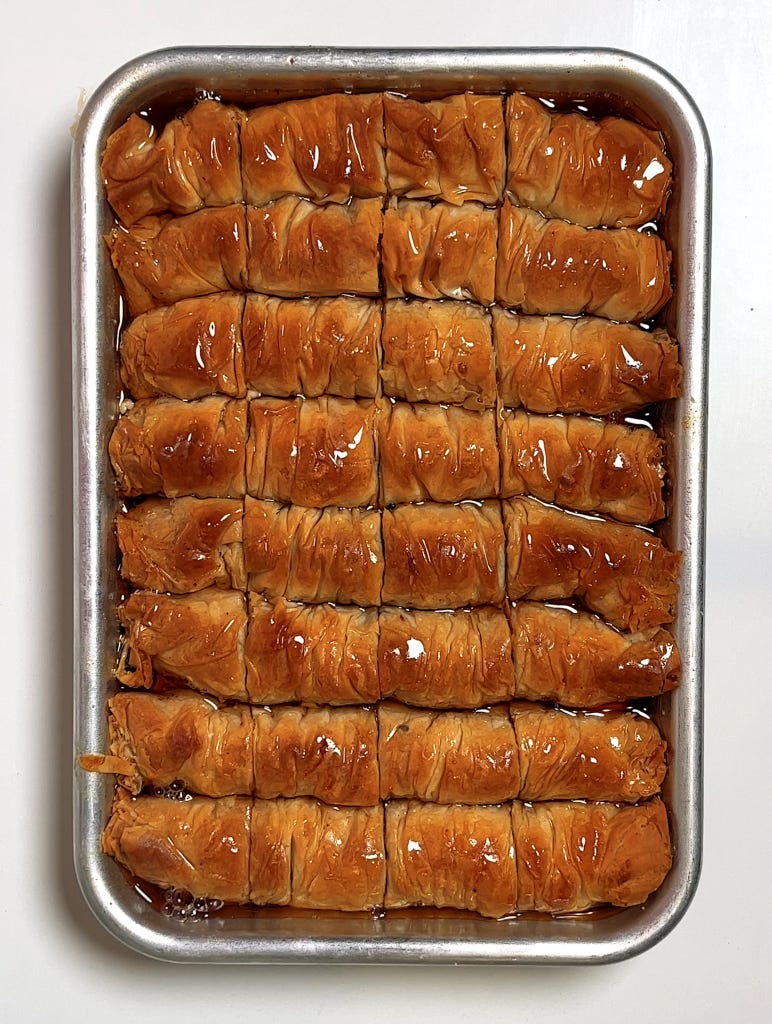
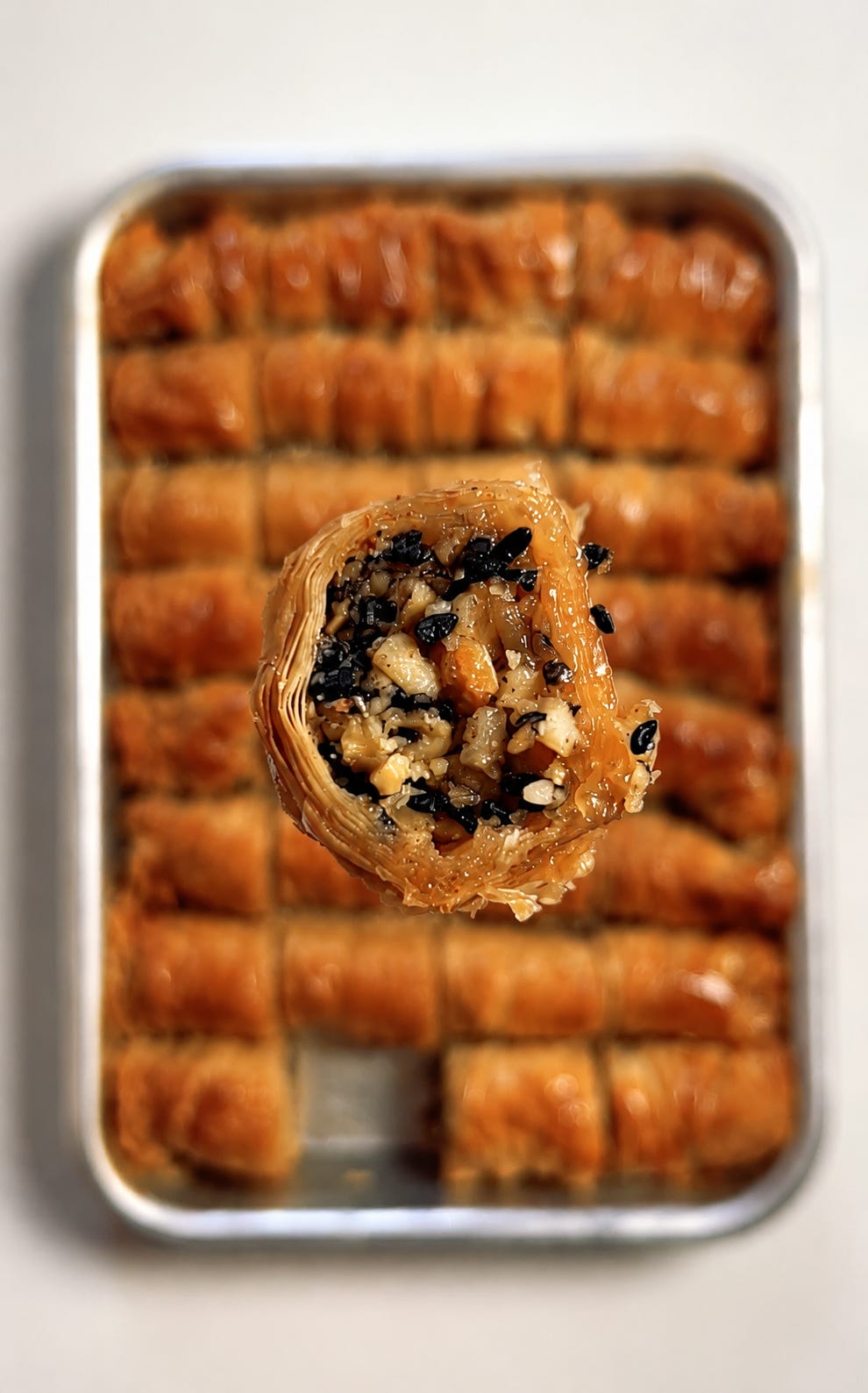
Baklava
120 g unsalted cashews
50 g black sesame seeds
1/2 tsp kosher salt
1/2 tsp Sichuan peppercorn powder
8 oz phyllo sheets (half of 16oz package) thawed
85 g butter (6 tbsp) melted
Syrup
100 g honey
120 g sugar
90 mL water
1 tsp chili flakes preferrably er jing tiao
1 tsp Sichuan peppercorns use 1/2 tsp and skip toasting if using powder
Instructions
Heat oven to 375F. Brush an eighth sheet pan (6.5” x 9.5”) or 8” round pan with melted butter.
To make the filling, add 120 g unsalted cashews, 50 g black sesame seeds, 1/2 tsp kosher salt, and 1/2 tsp Sichuan peppercorn powder to a blender or food processor and pulse until finely chopped. Alternatively, use a knife to finely chop cashews and stir together with remaining filling ingredients.
Work with one phyllo sheet at a time, and cover remaining sheets with a damp towel to prevent drying out.
Completely unfold one phyllo sheet and brush with melted butter. Fold in half along long edge (hamburger style) and brush top of folded sheet with more butter.
Lay a skewer or chopstick 2 inches from top of phyllo sheet and place 3 Tbsp of filling below skewer. Use the skewer to fold top of the phyllo sheet around filling and roll downwards. Once rolled, scrunch the roll towards the center of the skewer to create ridges.
Slide the skewer out and place rolled baklava into the prepared pan. Repeat with remaining phyllo and filling until the pan is full.
Brush the top of the rolls in the pan with butter. Use a paring knife to cut baklava into 1-2” segments. Bake at 375F for 25 minutes.
In the meantime, prepare the syrup. Add 1 tsp chili flakes and 1 tsp Sichuan peppercorns to a small saucepot. Dry toast over medium heat for 3 minutes, until fragrant.
Add 100 g honey, 120 g sugar, and 90 mL water to toasted spices. Bring to a boil then simmer uncovered for 5 minutes. Remove from heat and strain hot honey syrup through a fine mesh sieve.
Once the baklava is done baking, remove from the oven and immediately pour syrup evenly over the rolls. Allow the baklava to rest until completely cool, ideally overnight, before consuming.
Store baklava in an airtight container at room temperature for up to 2 weeks.
Protein Persian Saffron Ice Cream
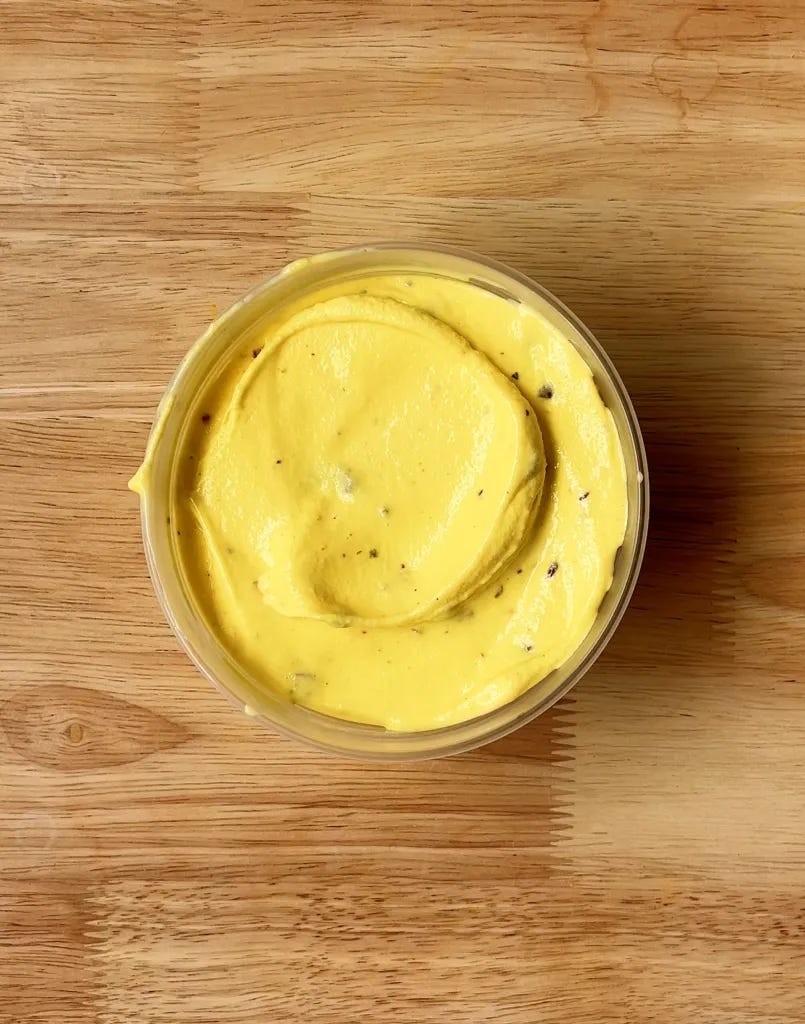
It’s officially Ninja Creami szn. I dusted off the old bowl, and now that I actually have space in my freezer, can start churning out pints again. One of my go-tos has been this Persian Bastani Sonati riff—one of, if not, my favorite flavor of ice cream.
Ingredients
325 mL lite coconut cream
450 mL Alexandria A2 4% milk
2 scoops vanilla protein powder
Monkfruit sweetener, to taste (adjust to preferred sweetness)
30 g skim milk powder
0.1 g saffron (~15 threads, crushed)
2 tsp rosewater
15 g cornstarch (1.5 tbsp)
1/2 tsp kosher salt
60 g roasted pistachios, chopped (about 1/2 cup)
Instructions
In a small bowl, place the saffron over a small ice cube to bloom the saffron. Allow the ice to melt completely.
In another small bowl, whisk together about 50 mL of the Alexandria A2 milk with the cornstarch until completely smooth. Set aside.
Prepare an ice bath with equal parts ice and water and set aside.
In a medium saucepan, combine the saffron water, remaining Alexandria A2 milk, lite coconut cream, vanilla protein powder, monkfruit sweetener, skim milk powder, and kosher salt.
Heat over medium heat, stirring frequently, until the mixture begins to simmer. Re-whisk the cornstarch slurry, then slowly pour it into the saucepan while whisking continuously.
Continue cooking for 1–2 minutes until the mixture thickens slightly and returns to a gentle simmer.
Strain through a fine mesh sieve into a heatproof container. Place the container into the ice bath and cool completely.
Once cooled, stir in the rosewater. Cover and refrigerate overnight, ideally at least 8 hours, to fully develop the flavor and texture.
Freeze the chopped pistachios overnight in a separate container.
Pour the chilled base into a Ninja Creami pint container and freeze for 24 hours until completely solid.
Spin using the “Lite Ice Cream” setting on the Ninja Creami.
After the first spin, create a small hole in the center, add the frozen pistachios, and process using the “Mix-In” function.
3. Best Songs of the Week:
4. Found This Amusing (Via Reddit):
Sad, but true.
The Texas Rangers Have No Aura
I am a lifelong Rangers fan, grew up in DFW, attended a game during all 3 World Series runs, and have been to at least one game every single year since 2009. This post is not meant to be Rangers hate, rather some Rangers tough love, and a dose of reality. In this post I will explain what I believe to me the main issue with the franchise in its current form, the fact that we have no aura.
What do I mean the Rangers have no Aura?
Here in 2026, I believe the Texas Rangers are one of the most vanilla franchises in the MLB, and thus one of the most irrelevant. There simply is no spice, no flare, nothing iconic about this team. Take another randomly generated team for example, the Atlanta Braves. Why do the Braves have aura? Firstly they have the classic uniforms that really look great on screen. The team has some players who provide some swagger such as Ronald Acuna jr, Michael Harris, and Chris Sale. The stadium is outside so at least the ballpark can provide a good view during the games. Take another randomly generated team: The Milwaukee Brewers. What gives the Brewers aura? They have a very unique Wisconsin charm. They have a great uniform lineup, each of which iconic in their own ways. They had Bob Uecker for the longest time, and they still have Brian Anderson announcing with passion. They have some super fun traditions such as “Roll out the Barrell” during the 7th inning stretch, and the sausage race. Just something to give the team some flair, some pop, some aura. The Rangers have nothing that makes them stand out, and I’m about to explain several reasons why.
Soulless Shopping Mall stadium.
The new stadium has terrific air conditioning. That’s about it. I once heard someone describe the new stadium as “A shopping mall where a baseball game broke out” and I think that’s about sums it up perfectly. There’s no Texas charm. The concourses have nothing but soulless, overpriced concessions, nothing unique (this year there’s a few things such as the sombrero hat that are an improvement, but still not great). The lighting is bright white and feels artificial. You can’t actually walk around the entire stadium, due to parts of it being off limits unless you are a club member. There are no iconic stadium views, no baseball sunsets, no views of downtown. You can barely even see the fans in the stadium, because of the stupid club seats behind home plate. It’s a soulless crypt that is the main problem with the death of Texas Baseball. The old temple had aura, it had an iconic look, it has the white scaffolding in center field, the center field hill, just SOMETHING to give it some personality. The new stadium has nothing.
The TV Announcers Suck
I have not heard much about this on this sub, so maybe this is a hot take. But Dave Raymond and Mike Bacsik have become borderline unwatchable. I find myself watching the game on mute, or switching to the opponents broadcast more often than listening to these two drone on. It sounds like they are announcing golf. They seldom have voice inflection, seldom add any useful commentary, and just make me want to take a nap. Replacing these two with anybody with a tad of personality would be a step in the right direction.
We got rid of our most iconic uniforms
A serious source of aura is a nice, iconic uniform. While I get it, we will never be the Yankees or the Dodgers, the old uniforms with “Texas” across the front have some Texas charm, and at least bring me back to my fond childhood memories watching this team. I would make the argument that in the year 2026, our best uniforms, or at least most iconic, are our gray ones. We should bring back the “Texas” on the white jerseys. While there is nothing inherently wrong with the cursive “Rangers”, it just doesn’t hold the same nostalgia as the old ones did. The blue jerseys are fine, but I believe Ranger Red has the more iconic look.
Nobody on the team with any swagger
During our championship season we had some players with swagger. I think Max Scherzer did a lot for this team to add some passion to the clubhouse. Now it feels like most of our players are either going through the motions, or are just quiet guys. No offense to Corey Seager, but he doesn’t provide the same personality to the team as someone like Elvis Andrus or Adrian Beltre did. Having a diva like Rougned Odor really provides some life to watching these games, and I think the current version of the team feels like just a bunch of dudes going through the motions.
The fans are getting priced out of the games
Ticket prices are on the rise, and the only affordable tickets in the stadium are in the upper deck. If anyone else watches a lot of hockey, the Toronto Maple Leafs stadium is sometimes called the “Yacht Club” because the only people that can afford to go to the games are the ultra rich. This makes the stadium and the fans feel less passionate, because everyone at the games that you can see on TV is a business exec showing off their money with a home plate suite. Not to mention, Arlington is impossible to get to in any reasonable amount of time, making going to the games not only expensive, but a serious time commitment as well.
That’s all I’ll say today. I love this team and want to see them succeed. Right now I find the every day regular season broadcast borderline unwatchable out of boredom. I watch a Brewers game or a Dodgers game and there’s so much more life to them, to the broadcast, to the stadium vibes, and then I turn on the Rangers and it puts me right to sleep. I want to bring back some Texas charm, some lone Star state swagger to this team, and I think right now the team feels like a soulless corporation, not a baseball team.
Have a blessed week and party hardy this Memorial Day weekend, y’all.
Also pray for my Spurs to stay up on Sunday.